
6 Best Mouse for SketchUp for 3D Design
The Logitech M720 Triathlon Wireless Mouse is the best mouse for sketchup for most buyers, mainly because it combines a comfortable right-handed shape with control across three devices. Its 115 x 74 x 45 mm body gives your palm room without taking over a typical desk. Bluetooth and Logitech’s USB receiver add flexibility for laptops, desktops, and tablets.
This guide is for students, architects, hobbyists, and professionals who spend hours orbiting, selecting, and measuring in SketchUp. The key details are hand fit, button layout, tracking control, and battery life, since a cramped grip or frequent battery swaps can interrupt detailed work. The six picks below are ranked with clear reasons and honest drawbacks for each, so you can match the mouse to your desk, workflow, and budget.
Quick Comparison
| # | Product | Best For | Price | |
|---|---|---|---|---|
| 1 | Logitech M720 Triathlon Wireless Mouse | Multi-device office users | $34.95 | View → |
| 2 | WisFox Wireless Mouse | Budget everyday computer users | $9.99 | View → |
| 3 | Logitech G305 Wireless Gaming Mouse | Wireless PC gaming enthusiasts | $36.00 | View → |
| 4 | Lenovo WL310 Bluetooth Silent Mouse | Quiet shared workspace users | $13.99 | View → |
| 5 | XBG B15Pro Wireless Mouse | RGB-equipped desk setup owners | $23.39 | View → |
| 6 | TECKNET Ergonomic Vertical Wireless Mouse | Wrist-conscious productivity workers | $24.99 | View → |
6 Top Mice for SketchUp
This ranked list counts down from sixth place to the top pick, with options for precision, comfort, and reliable modeling control.
6. TECKNET Ergonomic Vertical Wireless Mouse

Best for: Small and medium hands
The TECKNET ergonomic mouse uses a 52-degree vertical shape to encourage a handshake-style grip. It supports small and medium hands, with six buttons, side forward and back controls, and a DPI switch. Sensitivity ranges across six levels from 800 to 4,800 DPI. At $24.99, it targets office work, browsing, and light gaming without the cost of premium ergonomic models.
Connection options include Bluetooth 5.0, Bluetooth 3.0, and a 2.4GHz USB-A receiver. You can switch among three devices, which suits desks with a laptop, tablet, and desktop. The built-in 600mAh battery charges through USB-C. TECKNET claims about two months of use after a 1.5-hour charge, though actual battery life depends on usage. Quiet-click switches reduce noise by a claimed 99%, while the buttons are rated for 6 million clicks. Compatibility covers Windows 11 through XP and Mac OS X 10.4 or later. The mouse supports a 36-month warranty for registered users.
Pros
- Three connection methods support up to three devices.
- Six DPI settings cover detailed work and faster cursor movement.
- Rechargeable 600mAh battery avoids disposable cells.
Cons
- The vertical design may require an adjustment period for users accustomed to standard mice.
- Forward and back buttons do not work on Mac computers.
5. XBG B15Pro Wireless Mouse

Best for: Quiet, multi-device workstations
The XBG B15Pro is a rechargeable wireless mouse for laptops, tablets, and desktop PCs. It supports Bluetooth 5.0, Bluetooth 4.0, and 2.4GHz wireless, with device switching listed at 0.8 seconds. A built-in LED display shows battery percentage, connection type, and the selected DPI. You can choose from 800, 1000, 1200, 1600, or 2400 DPI.
Its 500 mAh battery charges through USB-C, so it does not need disposable AA cells. The mouse enters sleep mode after five minutes without activity, which should help conserve power. Silent buttons suit shared offices, libraries, and late-night work. A matte surface helps limit visible fingerprints, while the thumb rest, palm support, and textured grip are designed for longer sessions. It works with Windows, macOS, Linux, and Android. The $23.39 price also includes a 30-day return period and a one-year replacement promise.
Pros
- Three connection methods support laptops, tablets, and PCs.
- The screen displays battery level, DPI, and connection mode.
- USB-C charging and silent clicks fit travel and quiet offices.
Cons
- The product listing does not provide exact dimensions or weight, making fit harder to judge before purchase.
- Battery runtime and charging time are not specified, so users cannot estimate how often charging will be needed.
4. Lenovo WL310 Bluetooth Silent Mouse

Best for: Quiet laptop work and travel
The Lenovo WL310 is a compact Bluetooth mouse for Windows PCs, MacBooks, Chromebooks, and Lenovo laptops. Its grey, lightweight design fits easily in a laptop bag, while Bluetooth 5.0 connects without a USB receiver. That makes it useful for computers with limited ports or for users who prefer a cleaner desk. At $13.99, it targets basic work, study, and home-office needs rather than premium features.
Its quiet clicks suit libraries, shared offices, bedrooms, and late-night work. The ergonomic shape is designed to reduce wrist strain during longer sessions, though comfort can vary by hand size and grip style. Three DPI options, 1000, 1200, and 1600, let you choose slower control for documents or quicker movement across a larger screen. This range works for everyday tasks and light design work, but it may feel limited for users who want detailed gaming adjustments or programmable controls.
Pros
- Silent clicks create less noise in shared spaces and quiet rooms.
- Bluetooth 5.0 works without occupying a USB port or requiring a receiver.
- Three DPI settings provide basic speed and precision control.
Cons
- The 1000 to 1600 DPI range is modest for serious gaming or detailed creative work.
- Bluetooth-only connection may not suit older devices without Bluetooth support.
3. Logitech G305 Wireless Gaming Mouse

Best for: Budget-conscious PC and laptop gamers
The Logitech G305 Lightspeed is a wireless gaming mouse priced at $36. It uses Logitech’s HERO optical sensor with sensitivity up to 12,000 DPI, giving players precise control across fast movements and small adjustments. Its LIGHTSPEED wireless connection targets a 1 ms response time, which suits competitive games and everyday desktop use.
Power comes from one AA battery, with a rated runtime of up to 250 hours. That is a strong figure for a mouse without a built-in rechargeable cell. The classic shape and lightweight mechanical construction should feel familiar to many right-handed users, while six programmable buttons provide useful control options. The USB wireless receiver stores inside the mouse for transport, making this a practical choice for laptops and small gaming setups. At this price, the feature mix is hard to ignore, especially for buyers who want wireless play without paying premium prices.
Pros
- 12,000 DPI HERO sensor supports precise aiming and cursor control.
- 1 ms LIGHTSPEED connection reduces wireless response delay.
- Up to 250 hours of use from one AA battery.
Cons
- It uses a replaceable AA battery instead of a built-in rechargeable battery.
- The mouse needs its USB receiver, so it does not offer a cable-free Bluetooth setup.
2. WisFox Wireless Mouse

Best for: Budget laptop users needing extra buttons
The WisFox 2.4GHz wireless mouse is a low-cost pointer for laptops, desktops, MacBooks, and compatible Chromebook setups. Its contoured grey shell includes six buttons, two thumb buttons, and a dedicated DPI switch. You can choose 800, 1200, or 1600 DPI for slower control or quicker cursor movement. The symmetrical shape suits right- and left-handed users, while the sweat-resistant coating may help during long work sessions.
A small USB receiver stores inside the battery compartment when not in use. The connection reaches up to 33 feet, which works well with a desktop or laptop connected to a television. The mouse enters a lower-power mode after one minute of inactivity and sleep mode after eight minutes. Double-clicking wakes it. Setup requires no driver, and the manufacturer lists compatibility with Windows 7 through 10, XP, Vista, Linux, and Mac devices. The 12-month warranty adds useful coverage at a $9.99 price.
Pros
- Three DPI settings make cursor speed easy to adjust.
- Six buttons include two side controls for browser navigation or shortcuts.
- Receiver storage and automatic sleep help with travel and power use.
Cons
- The USB receiver occupies a full USB port, and no Bluetooth option is listed.
- Battery type and expected battery life are not specified, so running costs are unclear.
1. Logitech M720 Triathlon Wireless Mouse
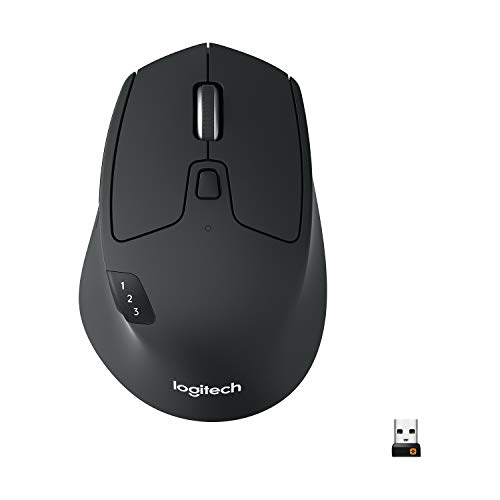
Best for: Right-handed users switching between computers
The Logitech M720 Triathlon is a full-size wireless mouse for computers, laptops, and tablets. It works with Windows, macOS, Chrome OS, Linux, and iPadOS. You can connect through Bluetooth or the included Logitech Unifying receiver. That receiver supports up to six compatible Logitech devices, which can reduce USB clutter. At $34.95, it offers broad device support without needing a wired connection.
Its rubber body and sculpted shape give your palm a steady resting place during long work sessions. The scroll wheel switches between click-to-click control and fast scrolling for lengthy pages or documents. A button lets you move between up to three computers, while Logitech FLOW can transfer the cursor, text, and files across supported systems. Six buttons can be assigned through Logitech software. The single battery is rated for up to 24 months, although actual life depends on use. The listed product carbon footprint is 5.08 kg CO2e.
Pros
- Connects to three computers and switches between them with a dedicated button.
- Supports Bluetooth and a Unifying receiver, with up to six compatible devices on one receiver.
- Offers a 24-month battery rating and two scrolling modes.
Cons
- The right-handed design does not suit left-handed users.
- Its full-size body is less convenient for small bags or tight desk setups.
Buying Guide
Precise tracking is the most important factor when choosing a mouse for SketchUp. It keeps cursor movement predictable during orbiting, selecting, measuring, and drawing tight lines.
- Sensor accuracy: Choose an optical sensor with adjustable sensitivity from about 800 to 3,200 DPI. Avoid models that skip or stutter during slow movements.
- Ergonomic shape: Match the mouse to your hand width and grip. A length near 4.5 to 5 inches suits many medium-to-large hands, while lighter models under 3.5 ounces reduce fatigue.
- Buttons and wheel: Look for at least five programmable buttons and a firm, clickable scroll wheel. Assign shortcuts such as Orbit, Pan, Zoom, Undo, and Select to reduce keyboard trips.
- Connection type: A wired USB model gives steady input with no charging. For wireless use, choose 2.4GHz or Bluetooth, with at least 50 feet of stated range and support for your operating system.
- Battery and price: Wireless models should provide at least 60 hours per charge, or several weeks with regular use. A useful budget is $30 to $100, depending on button count and build materials.
If you cannot have everything, prioritize sensor accuracy and a comfortable shape, since both affect every modeling session.
Frequently Asked Questions
How do I choose a mouse for SketchUp?
Choose a mouse for SketchUp with a precise sensor, a clickable scroll wheel, and at least two programmable side buttons. A wired model can reduce connection issues, while a wireless option suits tidy desks. Look for sensitivity adjustment around 800 to 3,200 DPI when switching between detailed drawing and broad model views.
What mouse features matter most for 3D modeling?
The most useful features are a smooth middle wheel, accurate tracking, a comfortable grip, and buttons that support orbit, pan, or shortcut commands. A tilt wheel is optional, not essential. Prioritize a wheel that scrolls in small steps, since zooming through a 3D model often requires more control than web browsing.
Can a gaming mouse work well with SketchUp?
Yes, a gaming mouse can work well in SketchUp if its shape feels comfortable and its buttons can be remapped. High polling rates do not improve model quality by themselves. A practical choice may offer six to eight buttons, adjustable DPI, and software that saves custom shortcuts for frequently used commands.
Are vertical mice good for SketchUp users?
Vertical mice can suit SketchUp users who want a more upright wrist position, but they may take time to control during orbiting and precise selections. Give yourself several days to adjust, and choose a model with a responsive wheel, two main buttons, and a return policy in case the shape feels awkward.
Conclusion
The Logitech M720 Triathlon Wireless Mouse is the strongest choice for SketchUp users who want comfortable daily control, quiet clicks, wireless flexibility, and easy switching between several computers. If your priority is maximum precision for detailed models, choose a wired mouse with adjustable DPI and programmable side buttons instead, since a fixed connection and extra controls can suit long modeling sessions better. Before buying, double-check the mouse size against your hand, confirm compatibility with your computer and operating system, check how many devices or accessories the package includes, and compare the current price across retailers. SketchUp work rewards steady pointer movement, but the right fit depends on your desk setup, shortcuts, travel needs, and tolerance for charging or replacing batteries.
