
7 Best Microscope for Coins for Collectors
The TOMLOV DM4W Digital Microscope with Weighing Scale is our top pick for most buyers and the best microscope for coins. Its main advantage is the useful combination of enlarged digital views and coin weighing in one compact setup. That makes it easier to inspect dates, mint marks, scratches, edges, and surface details while also checking a coin’s weight.
This guide is for collectors, sellers, hobbyists, and anyone sorting inherited or loose coins. For this type of magnifier, clear image quality and even lighting matter most, while the scale’s capacity and measurement resolution can affect identification. Screen size, camera adjustment, and the space available beneath the lens also shape daily use. The 7 picks below are ranked with reasons and honest drawbacks for each, so you can match the tool to your collection, budget, and preferred viewing method.
Quick Comparison
| # | Product | Best For | Price | |
|---|---|---|---|---|
| 1 | TOMLOV DM4W Digital Microscope with Weighing Scale | Coin collectors checking weight and detail | $44.99 | View → |
| 2 | Elikliv EDM4 LCD Digital Microscope | Students learning hands-on microscopy | $33.23 | View → |
| 3 | TOMLOV DM9 Digital Microscope | Craft hobbyists inspecting small objects | $95.99 | View → |
| 4 | TOMLOV DM4W Max Digital Coin Microscope | Serious collectors needing larger viewing area | $99.98 | View → |
| 5 | Elikliv Digital Coin Microscope with Scale | Buyers sorting coins by weight | $49.99 | View → |
| 6 | PalliPartners Digital Coin Microscope | Beginners identifying coin surface marks | $47.97 | View → |
| 7 | Elikliv EDM4C Digital Coin Microscope | Travelers examining pocket finds | $42.73 | View → |
7 Top Coin Microscope Picks
This ranked list counts down from capable options to the top coin-viewing microscope for detail, clarity, and ease of use.
7. Elikliv EDM4C Digital Coin Microscope

Best for: Coin collectors checking details and weight
The Elikliv EDM4C combines a digital microscope and weighing scale in one compact station. Its 4.3-inch IPS screen shows coin surfaces, mint marks, jewelry settings, and small electronic parts. Magnification ranges from 2X to 1000X, while adjustable LEDs help reveal scratches and texture in dim spaces. The built-in scale reads in 0.1-gram steps, with stated accuracy within ±0.5 grams.
Its 8-inch, gear-driven metal stand provides more room for taller objects than a short desktop holder. The enlarged base should also help reduce movement during close inspection. A 178-degree viewing angle and 500 cd/m² brightness make the screen easier to share across a table or classroom. You can connect it to a Windows or Mac computer for larger-screen viewing, recording, and file storage. The built-in battery supports cordless use, though the listed features do not provide a runtime. At $42.73, it offers useful coin and jewelry tools in one unit, but serious authentication still requires proper testing equipment.
Pros
- Combines magnification and weighing, reducing the need for separate coin tools.
- The 4.3-inch IPS display offers 500 cd/m² brightness and a 178-degree viewing angle.
- The adjustable LED and 8-inch metal stand support detailed, stable inspection.
Cons
- The scale’s ±0.5-gram accuracy may not be precise enough for high-value metal testing.
- Battery runtime is not specified, so portable use may be difficult to plan.
6. PalliPartners Digital Coin Microscope

Best for: Coin collectors and hobby inspection
The PalliPartners Digital Microscope costs $47.97 and combines a 4.3-inch LCD screen with a 2.0MP camera. Its stated magnification range runs from 50X to 1000X, giving users a closer view of coin marks, stamps, insects, circuit boards, and jewelry. The screen shows the subject directly, so a separate computer or phone is not required. Focus comes from a manual wheel, and the included metal bracket supports hands-free viewing.
Eight built-in LED lights provide adjustable brightness around the lens. That helps when examining dark objects or shiny surfaces, though reflective coins may still need careful light positioning. The microscope records photos and video to the included 32GB microSD card, with listed 1080p and 720p resolution options. Its rechargeable lithium battery runs for a stated 4 to 5 hours, and the unit can be held without the bracket for outdoor observation. At this price, the stand, screen, storage card, and battery make it a practical hobby tool rather than a laboratory instrument.
Pros
- 4.3-inch LCD screen lets you view details without connecting another device.
- Eight adjustable LEDs help illuminate coins, gems, boards, and other small objects.
- Included 32GB microSD card stores photos and recorded video.
Cons
- The manual focus wheel requires careful adjustment, especially at higher magnification.
- It is not suitable for cell or medical inspection, limiting professional applications.
5. Elikliv Digital Coin Microscope with Scale
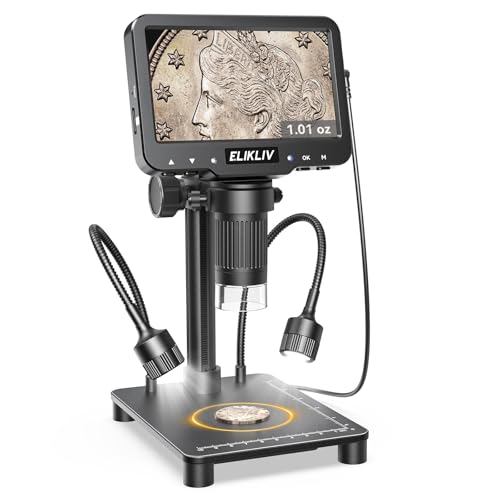
Best for: Coin collectors checking details and weight
The Elikliv combines a digital microscope with a 300g weighing scale. Its scale reads in 0.1g steps and supports grams, ounces, and carats, making it useful for coins, jewelry, and small components. A metal base plate helps keep items steady during quick readings. The 4.3-inch IPS display gives you a larger viewing area than a handheld loupe, with a 178-degree viewing angle for more comfortable inspection.
Eight adjustable lights around the lens and two side lights provide illumination for coins, stamps, jewelry, and small mechanical parts. The camera records 12MP photos and 1080p video, but you need to supply a Micro SD card. A USB connection provides a live view on Windows or Mac computers. The microscope detaches from its stand for outdoor use, and its battery lasts up to three hours per charge. At $49.99, the combination of viewing and weighing functions gives collectors more flexibility than a basic magnifier.
Pros
- Measures items up to 300g with 0.1g resolution in three units.
- Uses a 4.3-inch IPS screen and 10 adjustable lights for clearer inspection.
- Records 12MP photos or 1080p video without needing a smartphone.
Cons
- A Micro SD card is not included, so photo and video storage requires an extra purchase.
- Up to three hours of battery life may require recharging during longer shows, classes, or field trips.
4. TOMLOV DM4W Max Digital Coin Microscope

Best for: Coin collectors checking details and weight
The TOMLOV DM4W Max combines a digital microscope and scale in one compact setup. Its 7-inch screen displays coins and small objects, while the built-in scale measures in 0.1g increments with stated accuracy of ±0.5g. You can switch among grams, ounces, carats, and troy ounces. That covers common coins, precious metals, jewelry, and gemstones. The $99.98 price also avoids buying a separate scale.
Its upgraded lens can show many coins up to 32mm in one view. Larger pieces may need repositioning. The microscope records 2K video and captures photos up to 5440×3060 pixels, useful for mint marks, scratches, edge wear, and surface errors. LED lighting helps reduce shadows, and the taller stand leaves room around the weighing area. A USB connection sends the live view to a computer. Keep expectations realistic, though. The built-in display is 800×480, and the scale’s half-gram accuracy suits reference checks better than precise buying or selling measurements.
Pros
- Combines close-up inspection and weighing in one device.
- Supports four units, including carats and troy ounces.
- Captures high-resolution photos and 2K video for records or sharing.
Cons
- The 800×480 screen is much lower resolution than the camera’s maximum photo output.
- ±0.5g accuracy may be insufficient for exact precious-metal verification or professional grading.
3. TOMLOV DM9 Digital Microscope

Best for: Coin collectors and hobby electronics
The TOMLOV DM9 is a desktop digital microscope with a built-in 7-inch LCD screen. Its 12MP camera supports 1080p video, while the adjustable stand lets you change the viewing distance and focus. The 8.5-inch metal stand and solid metal base should provide a steadier platform than a handheld magnifier. The base is also heat-resistant for light soldering work.
This microscope fits coin inspection, PCB checks, jewelry viewing, and other small projects. Eight built-in LEDs provide adjustable brightness, and two flexible gooseneck lights add illumination from different angles. You can save photos and inspection records to the included 16GB microSD card. A wired remote control is included, and the unit can connect to a Windows or Mac computer for a larger live view. The screen makes shared viewing easier than peering through a small eyepiece. The advertised 1200X magnification may help reveal dates, mint marks, scratches, and solder joints, though useful detail will depend on working distance and lighting.
Pros
- The 7-inch screen offers a comfortable view for comparing coins and showing details to others.
- A metal base and 8.5-inch stand provide a stable setup for inspection and light soldering.
- The 12MP camera, 1080p video, and 16GB card support collection records and project documentation.
Cons
- The unit takes up dedicated desk space, unlike a compact handheld magnifier.
- Digital magnification can reduce practical detail at higher settings, so 1200X should not be treated as microscope-grade optical magnification.
2. Elikliv EDM4 LCD Digital Microscope

Best for: Coin collectors checking details
This $33.23 Elikliv digital microscope combines a camera, a 4.3-inch LCD, and an adjustable stand in a compact inspection setup. Its 720p image appears on the built-in screen, so you can examine coin dates, mint marks, jewelry, stamps, circuit boards, and small repair work without using an eyepiece. The 1000x label needs context. Actual enlargement changes with the camera-to-object distance and the screen used.
Eight adjustable LEDs surround the lens and help illuminate darker objects. The stand changes the camera height, which gives you more control over focus and magnification than a fixed handheld view. A rechargeable battery provides up to three hours of continuous use, making short inspection sessions possible away from an outlet. Windows and MacBook computers can show a larger live view, and the microscope can capture photos or video for later review. A memory card is required for saved files, but it is not included.
Pros
- The 4.3-inch screen provides a direct live view without a separate monitor.
- Eight adjustable LEDs help reveal surface details on coins and other small objects.
- The height-adjustable stand supports more precise focus at different working distances.
Cons
- The 720p display may not show the finest details as clearly as a higher-resolution microscope.
- Photo and video storage requires a separate memory card before recording files.
1. TOMLOV DM4W Digital Microscope with Weighing Scale

Best for: Coin collectors checking authenticity
The TOMLOV DM4W combines a digital microscope and weighing scale in one $44.99 unit. Its 4.3-inch IPS screen shows coin surfaces, jewelry, circuit boards, and other small items at 10X to 200X magnification. Built-in LED lighting helps reveal scratches, lettering, metal texture, and surface wear without a separate lamp. The stand rises 8 inches and uses an enlarged base with a metal support rod for added stability.
The integrated scale measures in grams, ounces, or carats. It offers 0.1g resolution, with stated accuracy of plus or minus 0.5g, which suits coin checks and basic jewelry work better than highly precise laboratory measurements. A USB output connects to Windows or Mac computers for a larger live view, recording, or classroom sharing. The built-in battery also allows use away from an outlet, though its runtime is not specified.
Pros
- Combines magnified inspection and coin weighing in one device.
- Bright 4.3-inch display has a 178-degree viewing angle.
- USB output supports larger-screen viewing on Windows and Mac.
Cons
- The stated ±0.5g accuracy may be too coarse for very small gemstones or fine jewelry work.
- Battery runtime is not listed, which makes field-use planning difficult.
Buying Guide
Optical clarity matters most when choosing a coin microscope. Clear 10x to 40x views reveal scratches, mint marks, and die varieties better than inflated digital magnification.
- Useful magnification: Choose a stereo model with 10x to 40x optical magnification, or a digital unit with honest 20x to 60x detail. Claims above 1,000x often add empty zoom rather than useful information.
- Lighting control: Look for adjustable LED lighting, ideally with a ring light plus side illumination. Brightness control helps reduce glare on silver, proof, and polished surfaces.
- Working distance: Aim for at least 2 inches between the lens and coin at medium magnification. This leaves room for tweezers, a scale, or gentle surface cleaning.
- Stand stability: A metal stand with a weighted base is preferable to a flexible gooseneck. A 4-by-6-inch base or larger should resist movement while focusing.
- Images and price: For photos, choose 1080p or higher output, adjustable focus, and USB or HDMI connectivity. Basic digital viewers cost about $40 to $100, while stereo systems commonly run $150 to $400.
If you cannot have every feature, prioritize optical clarity and steady focusing over extreme zoom or extra camera functions.
Frequently Asked Questions
How do I choose a microscope for inspecting coins?
Choose a coin microscope with adjustable LED lighting, 20x to 40x useful magnification, and a stable stand. A 2-megapixel camera can show date marks and mint letters on a phone or computer, while a metal stage reduces movement. Avoid extreme 1000x claims, since most coin details need a wider field of view.
What magnification is best for examining coins?
A magnification range of 20x to 60x works best for most coin inspection. Lower settings show the full surface, while higher settings help with tiny scratches, mint marks, and edge lettering. A zoom dial is more useful than one fixed claim, since advertised digital magnification can exceed useful optical detail.
Can a digital microscope identify coin details?
Yes, a digital microscope can identify many coin details, but it should not replace expert authentication. A 1080p display can reveal dates, mint marks, doubling, spots, and rim damage. Side lighting can reveal raised scratches, while diffuse light helps show color and surface marks without harsh glare.
Are USB microscopes good for viewing coins?
Yes, USB microscopes are good for coin viewing when you want a low-cost computer or phone setup. Many models need a separate stand, and a flexible gooseneck can shake when touched. Choose a unit with adjustable LEDs, a working distance of at least 30 millimeters, and software that supports saved images.
Conclusion
TOMLOV DM4W Digital Microscope with Weighing Scale is the strongest pick for coin collectors who want enlarged views plus quick weight checks in one compact setup. If your priority is sharper image detail for grading, choose a model with higher optical resolution and adjustable lighting instead, even if it costs more. Before buying, double-check the stand and coin-stage size, device compatibility with your phone or computer, the included accessory quantity, and the current price, since bundles and discounts can change. A built-in screen helps at a desk, while wireless viewing may suit shared collecting sessions. A stable base also matters for close inspection. The right coin viewer should fit your workspace, collection habits, and budget.
