
4 Best Monitor for Amd 5700 Xt on a Budget
For most buyers, the LG 27G850A-B UltraGear 4K Gaming Monitor is the top pick and the best monitor for amd 5700 xt because its 27-inch 4K display balances sharp detail with a manageable desk size. It is a gaming-focused screen for players who want clear images in modern games, plus enough resolution for work, streaming, and general use.
This guide is for Radeon RX 5700 XT owners choosing a replacement or first gaming display. The key checks are resolution, refresh rate, and adaptive-sync support, since the graphics card must drive the panel smoothly without wasting its capabilities. Screen size also affects desk space and viewing distance, while connection choices can determine how easily you use the monitor with a PC and other devices. The four picks below are ranked by their strengths, with clear reasons and honest drawbacks for each, so you can match the display to your games, desk, and budget.
Quick Comparison
| # | Product | Best For | Price | |
|---|---|---|---|---|
| 1 | LG 27G850A-B UltraGear 4K Gaming Monitor | 4K Console and PC Gamers | $599.99 | View → |
| 2 | XFX Radeon RX 5700 XT Graphics Card | Budget 1440p Gaming Builds | $899.99 | View → |
| 3 | Alienware Dell Aurora R10 Gaming Desktop | Plug-and-Play Desktop Gamers | $1,599.00 | View → |
| 4 | PowerColor Red Devil Radeon RX 6950 XT Graphics Card | High-Refresh 1440p Enthusiasts | $749.99 | View → |
4 Top Monitors for the Radeon RX 5700 XT
This ranked list counts down from fourth place to the top monitor pick for gaming, work, and everyday use.
4. PowerColor Red Devil Radeon RX 6950 XT Graphics Card
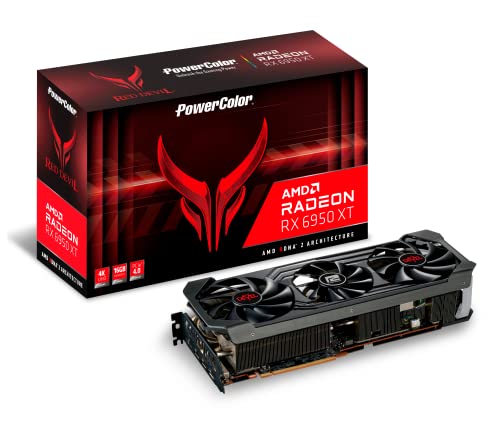
Best for: High-end 1440p and 4K gamers
The PowerColor Red Devil Radeon RX 6950 XT is a desktop graphics card priced at $749.99. It uses 16GB of GDDR6 memory across a 256-bit interface, giving demanding games room for high-resolution textures. Its PCIe 4.0 x16 connection fits modern gaming desktops, while support for DirectX 12 works with current graphics features. Windows 10 support and driver compatibility are also listed.
The card uses 5,120 stream processors and offers two firmware profiles. OC mode reaches a 2,226 MHz game clock and 2,435 MHz boost clock. Silent mode lowers those figures to 2,116 MHz and 2,324 MHz. Memory runs at 18.0 Gbps. That profile choice is useful for buyers who want higher rated speeds or a quieter operating target. Power requirements are substantial, though. PowerColor lists a 950W minimum system power supply, and the card needs three 8-pin PCIe connectors.
Pros
- 16GB of GDDR6 memory suits high-resolution gaming and large texture packs.
- The 5,120-stream-processor design supports demanding DirectX 12 workloads.
- OC and Silent profiles let buyers choose between rated speed settings.
Cons
- The listed 950W minimum system power is high, so some desktops need a power-supply upgrade.
- Three separate 8-pin connectors can make cable management harder in compact cases.
3. Alienware Dell Aurora R10 Gaming Desktop

Best for: PC gamers wanting strong 1440p performance
The Alienware Aurora R10 is a gaming desktop with a Ryzen 9 3900 processor, 32GB of dual-channel HyperX Fury DDR4 memory, and a 1TB solid-state drive. Its Lunar Light case gives the system a bright, distinctive look, while the included Radeon RX 5700 XT provides 8GB of GDDR6 graphics memory. At $1,599, this configuration targets buyers who want a ready-to-use Windows gaming tower with substantial memory and storage.
The 32GB RAM capacity is a strong point for modern games, streaming, and heavier multitasking. A 1TB SSD also provides useful room for several large game installs, with faster loading than a traditional hard drive. The RX 5700 XT remains capable for high-refresh 1080p play and many 1440p setups, though newer graphics cards offer better efficiency and features. The main concern is age. Both the Ryzen 3000 processor and RX 5700 XT belong to an older hardware generation, which makes the $1,599 price harder to justify unless the Aurora design and included configuration fit your needs.
Pros
- 32GB of dual-channel DDR4 supports gaming, streaming, and multitasking.
- The 1TB SSD offers faster load times and useful game storage.
- Radeon RX 5700 XT includes 8GB of GDDR6 memory for demanding graphics settings.
Cons
- The Ryzen 9 3900 and RX 5700 XT are older components at this price.
- The $1,599 cost leaves less room for a newer graphics card or monitor.
2. XFX Radeon RX 5700 XT Graphics Card

Best for: 1440p gaming PC upgrades
The XFX Radeon RX 5700 XT is a desktop graphics card with AMD’s first-generation RDNA architecture and 8GB of GDDR6 memory. Its memory bandwidth reaches 448 GB/s, giving it the capacity for demanding 1440p games. The card uses PCI Express 4.0, which supports 16 GT/s and offers twice the theoretical bandwidth of PCIe 3.0.
What stands out is the feature mix for responsive gaming. Radeon Anti-Lag can reduce the delay between input and on-screen action, while AMD FreeSync helps match the display’s refresh rate to the card’s output. Radeon Image Sharpening and FidelityFX can improve visual clarity in supported games. Connectivity includes three DisplayPort outputs and one HDMI port. At $899.99, though, this is a difficult purchase to justify unless the seller’s pricing reflects a rare or limited supply situation. This GPU is also from an older generation, so newer cards may offer better efficiency and features.
Pros
- 8GB of GDDR6 memory and 448 GB/s bandwidth suit 1440p gaming.
- Three DisplayPort connections and one HDMI output support multi-monitor setups.
- PCIe 4.0 provides 16 GT/s of interface bandwidth.
Cons
- The $899.99 price is extremely high for an older RX 5700 XT.
- It lacks dedicated hardware for modern ray-tracing effects.
1. LG 27G850A-B UltraGear 4K Gaming Monitor
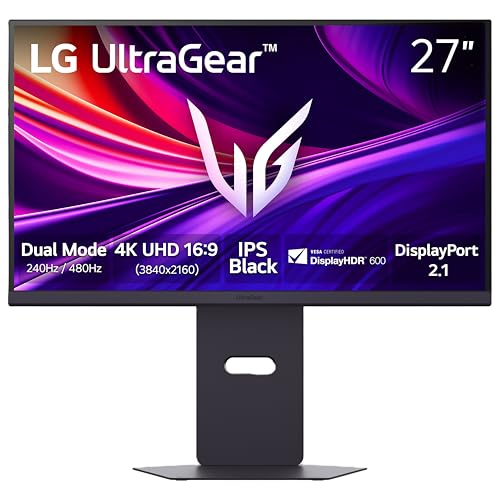
Best for: 4K competitive PC gamers
The LG 27G850A-B is a 27-inch 4K UHD gaming monitor priced at $599.99. Its Nano IPS Black panel runs at 240Hz in 3840 x 2160, then switches to 480Hz at Full HD through Dual Mode. A 1ms GtG response time targets quick motion, while NVIDIA G-SYNC compatibility and AMD FreeSync Premium Pro support variable refresh rates with compatible hardware.
The image package is strong on paper. VESA DisplayHDR 600, up to 99% DCI-P3 coverage, 10-bit color, and Nano IPS Black aim to provide brighter highlights, broad color, and deeper blacks than a standard IPS display. Connectivity includes DisplayPort 2.1, two HDMI 2.1 ports, and USB 3.2 Gen 1 with one upstream and two downstream ports. A four-pole headphone jack combines audio and microphone connections. DTS Headphone:X adds positional audio processing, and the Switch app can divide the screen into six sections or access the built-in webOS streaming platform.
Pros
- 240Hz 4K supports detailed, high-refresh PC gaming.
- 480Hz Full HD mode suits competitive shooters and racing games.
- Two HDMI 2.1 ports, DisplayPort 2.1, and USB ports cover modern setups.
Cons
- 480Hz mode drops the resolution to 1920 x 1080, sacrificing image detail for speed.
- HDR performance depends on game support and display settings, so DisplayHDR 600 does not guarantee OLED-level contrast.
Buying Guide
Refresh rate and adaptive-sync support matter most for an AMD Radeon RX 5700 XT. A 144Hz to 165Hz panel with AMD FreeSync can reduce tearing while matching the card’s strong 1080p and 1440p gaming performance.
- Resolution and size: Choose a 27-inch, 2560×1440 monitor for sharper images and useful screen space. A 24-inch, 1080p model costs less and suits competitive gaming.
- Refresh rate: Target at least 144Hz, or 165Hz if the price difference is small. The 5700 XT can often reach high frame rates at 1080p and playable high rates at 1440p.
- Adaptive sync: Look for AMD FreeSync or FreeSync Premium with a range starting near 48Hz and reaching at least 144Hz. Confirm that the feature works through DisplayPort.
- Response and panel type: Pick an IPS panel with a quoted 1ms to 5ms response time for balanced color and motion clarity. VA panels offer deeper blacks but may show more dark-level smearing.
- Connections and cost: Include DisplayPort 1.2 or newer, HDMI 2.0 or newer, and a VESA mount if needed. A sensible budget is $200 to $350 for a 1440p gaming display.
If money is limited, prioritize FreeSync coverage and a 144Hz refresh rate before HDR or built-in speakers.
Frequently Asked Questions
What resolution is best for a monitor paired with the AMD Radeon RX 5700 XT?
A 1440p monitor is the best overall match for the AMD Radeon RX 5700 XT. This resolution delivers sharper images than 1080p without the heavier workload of 4K. Look for a 27-inch screen with a 144Hz or 165Hz refresh rate for a strong balance between detail and smooth motion.
Can the RX 5700 XT run a 144Hz gaming monitor?
Yes, the RX 5700 XT can run many games at 144Hz, especially at 1080p or 1440p with adjusted settings. Actual frame rates depend on the game, graphics preset, and resolution. Competitive titles may reach 144 frames per second, while demanding releases could require lower settings or a slower refresh target.
Are FreeSync monitors a good choice for this graphics card?
Yes, FreeSync monitors are a good choice because the RX 5700 XT supports AMD FreeSync. This feature matches the display’s refresh rate to changing frame rates, which can reduce tearing and stutter. A display with a 48Hz to 144Hz variable refresh range gives the card useful flexibility during gameplay.
Do I need HDMI 2.1 for an RX 5700 XT monitor?
No, you do not need HDMI 2.1 for an RX 5700 XT monitor. DisplayPort 1.4 or HDMI 2.0 can handle common 1440p gaming setups at high refresh rates. Check the graphics card’s available ports before buying, since DisplayPort often provides the easiest path to 144Hz at 1440p.
Conclusion
The LG 27G850A-B UltraGear 4K Gaming Monitor is the top recommendation for 5700 XT owners who want sharp 4K detail in a 27-inch gaming display. If your priority is smoother motion and easier frame rates, choose a 1440p monitor with a high refresh rate and FreeSync support instead. Before buying, double-check the screen size, DisplayPort and FreeSync compatibility with your graphics card, the number of monitors you need, and the current price, since deals change often. A 5700 XT can drive demanding games at 1440p more comfortably than 4K, so match the panel to your favorite titles and settings. That approach helps you avoid paying for pixels you may not use.
