
5 Best Telescope Zoom Eyepiece for Beginners
The SVBONY SV135 Zoom Telescope Eyepiece is the top pick for most buyers. It earns the title of best telescope zoom eyepiece because its 7-21mm focal-length range covers low- and higher-power viewing without swapping eyepieces. Its 1.25-inch barrel fits many common telescope focusers, and the zoom design keeps sessions simple. Still, its narrower field of view at 21mm may disappoint users who want wide views of star fields.
This guide is for new stargazers, casual observers, and experienced users who want one flexible eyepiece. The key factors include focal-length range, apparent field of view, optical quality, and barrel size. Compatibility matters too, since most telescopes accept 1.25-inch accessories, while some use 2-inch models. The five picks below are ranked with clear reasons and honest drawbacks for each.
Quick Comparison
| # | Product | Best For | Price | |
|---|---|---|---|---|
| 1 | SVBONY SV135 Zoom Telescope Eyepiece | Budget-Minded Lunar Observers | $49.99 | View → |
| 2 | Celestron 8-24mm Zoom Telescope Eyepiece | Beginner Stargazers Seeking Convenience | $89.99 | View → |
| 3 | NEEWER LS-T22 Zoom Telescope Eyepiece | Eyeglass Wearers Needing Eye Relief | $20.69 | View → |
| 4 | SVBONY SV191 Zoom Telescope Eyepiece | Planetary Detail Enthusiasts | $79.99 | View → |
| 5 | SVBONY SV215 Zoom Telescope Eyepiece | High-Power Visual Observers | $149.99 | View → |
5 Zoom Eyepieces for Clearer Views
This list is ranked from fifth place down to the top pick, with each telescope zoom eyepiece compared for practical features.
5. SVBONY SV215 Zoom Telescope Eyepiece

Best for: Planetary observers using 1.25-inch telescopes
The SVBONY SV215 is a 3mm-8mm zoom eyepiece for telescopes with a standard 1.25-inch focuser. That focal range covers six marked positions, at 3, 4, 5, 6, 7, and 8mm, so you can change magnification without swapping eyepieces. It suits close views of the Moon and planets such as Venus, Mars, Jupiter, and Saturn, though actual detail depends on your telescope and viewing conditions.
Its parfocal design limits refocusing as you move through the range, but SVBONY says minor adjustments may still be needed. The apparent field of view and usable eye relief remain consistent during zooming, which makes the view easier to manage. A six-element, four-group optical design uses fully multi-coated lenses for improved sharpness, contrast, and color correction. The zoom ring turns smoothly, while clicks mark each focal length for easier use in darkness. A rubber grip ring and safety undercut help secure the 1.25-inch barrel in the focuser. At $149.99, it costs more than basic single focal-length eyepieces.
Pros
- Six marked focal lengths reduce eyepiece changes during planetary viewing.
- Parfocal operation limits refocusing between zoom settings.
- Multi-coated, six-element optics support contrast and color control.
Cons
- The 3mm-8mm range is built for high magnification, not wide-field viewing.
- Minor refocusing may still be necessary, despite the parfocal design.
4. SVBONY SV191 Zoom Telescope Eyepiece

Best for: Stargazers wanting one flexible eyepiece
The SVBONY SV191 is a 1.25-inch zoom eyepiece with a 7.2-21.6mm focal-length range. That range changes magnification without requiring an eyepiece swap. Its apparent field of view shifts from 65° at the longer focal length to 42° at the shorter setting, giving you wider views for locating objects and closer views for lunar or planetary targets. The $79.99 price also makes it less costly than buying several fixed eyepieces.
Its seven-element, four-group optical design uses high-index glass for sharp, higher-contrast views on paper. The twist-up rubber eyecup and 18-20mm eye relief suit users who observe with glasses, although comfort can vary with face shape and glasses size. A standard 1.25-inch barrel fits many astronomy telescopes and spotting scopes. The base also includes an M28.5*0.6 thread for standard 1.25-inch filters, so existing filters can carry over. The main catch is operation. This is not parfocal, so you must refocus after changing the zoom setting. That can interrupt tracking or quick observations.
Pros
- Covers 7.2-21.6mm, reducing the need to change eyepieces.
- Offers a 42-65° apparent field of view for varied framing.
- Accepts standard 1.25-inch filters through its M28.5*0.6 thread.
Cons
- Requires refocusing after each zoom adjustment because it is not parfocal.
- A 1.25-inch format may not fit telescopes designed for 2-inch accessories.
3. NEEWER LS-T22 Zoom Telescope Eyepiece

Best for: Budget-conscious lunar and planetary viewing
The NEEWER LS-T22 is a 1.25-inch zoom eyepiece for telescopes that accept standard 1.25-inch accessories. Its focal length moves from 7mm to 21mm with a twist of the zoom ring, so you can switch from higher-magnification planetary views to wider landscape or sky views without swapping eyepieces. At $20.69, it offers a practical way to cover several viewing needs with one accessory.
Inside, five elements are arranged in three groups. NEEWER also uses multiple coatings to reduce glare and reflections while improving light transmission and contrast. The aluminum alloy body has a matte black finish, and the rubber eye guard helps block stray light. Eye relief measures 15mm, which can suit some glasses wearers, though comfort varies with eyeglass frames. The field of view ranges from 40° to 57°, giving the wider view at one end of the zoom range and a tighter view at the other. The small barrel size also keeps this eyepiece easy to carry with a compact telescope kit.
Pros
- 7-21mm zoom range: Adjust magnification without changing eyepieces.
- 15mm eye relief: Gives glasses wearers more viewing space than very short-relief designs.
- Five-element optical layout: Supports sharper views with reduced chromatic color and glare.
Cons
- 1.25-inch fit only: It will not directly fit telescopes designed for 2-inch eyepieces.
- 40° minimum field of view: The view becomes noticeably narrower at the highest magnification.
2. Celestron 8-24mm Zoom Telescope Eyepiece

Best for: Stargazers wanting one flexible eyepiece
The Celestron 8-24mm Zoom Telescope Eyepiece covers a broad range of viewing needs in one 1.25-inch barrel. Turn the zoom ring to choose any focal length from 8mm through 24mm, then match the magnification to the Moon, planets, or brighter deep-sky objects. The actual magnification depends on your telescope’s focal length. At $89.99, it can also reduce the need to buy several fixed focal length eyepieces.
Each lens surface receives multiple optical coatings, which can improve brightness, color, and contrast. The eyepiece fits telescopes and spotting scopes designed for standard 1.25-inch astronomical accessories. It also accepts 1.25-inch filters, giving you another way to tailor the view. A 2-year US warranty and unlimited support from US-based staff add useful purchase protection. Still, this is a practical all-purpose accessory, not a replacement for every specialized eyepiece in a larger collection.
Pros
- One eyepiece provides focal lengths from 8mm to 24mm.
- Fits compatible 1.25-inch telescopes and spotting scopes.
- Fully multi-coated optics support brighter, higher-contrast views.
Cons
- It only fits equipment that accepts 1.25-inch eyepieces, not 2-inch models.
- A zoom design may not match the widest field of view available from some fixed focal length eyepieces.
1. SVBONY SV135 Zoom Telescope Eyepiece
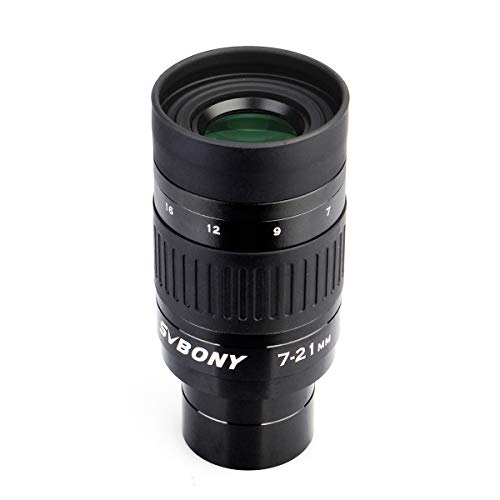
Best for: Lunar and planetary observers
The SVBONY SV135 is a 1.25-inch zoom eyepiece with an adjustable focal length from 7mm to 21mm. That range covers several common magnifications in one accessory, so it can reduce the need to swap eyepieces during an observing session. Its full-metal body should also handle regular transport better than a lightweight plastic housing. At $49.99, it targets telescope owners who want more flexibility without buying multiple fixed-length eyepieces.
Optically, the SV135 uses six elements in four groups, with fully multi-coated glass intended to improve contrast and sharpness across the view. Its apparent field ranges from 40° to 57°, depending on the zoom setting. Eye relief measures about 16.3mm to 18mm, which gives eyeglass wearers more viewing room than many basic designs. A rubber eyecup helps block stray light. This model suits the Moon, planets, star clusters, nebulae, and daytime landscapes. The 7mm setting can provide strong magnification, while the 21mm position offers a wider, easier starting view.
Pros
- One 7-21mm zoom range replaces several basic focal lengths.
- Six-element, four-group optics and full multi-coatings support sharper, higher-contrast views.
- 1.25-inch barrel fits telescopes that accept the common accessory size.
Cons
- The 40° to 57° field is narrower than many dedicated wide-angle eyepieces.
- A 7mm focal length may produce a dim or shaky image on telescopes with limited aperture or unstable mounts.
Buying Guide
Match the zoom eyepiece’s focal-length range to your telescope first. This choice controls magnification, field of view, and whether the eyepiece suits planets, the Moon, or deep-sky objects.
- Barrel compatibility: Choose a 1.25-inch model for most smaller telescopes, or a 2-inch model only if your focuser accepts that size. A 1.25-inch adapter can help, but it may not support every accessory.
- Focal-length range: Compare the eyepiece with your telescope’s focal length. For example, an 8-inch f/6 telescope has a 1,200mm focal length, so an 8-24mm zoom provides 50x to 150x magnification.
- Magnification limits: Stay near 50x per inch of aperture under excellent conditions, and use less on average nights. Excessive magnification produces a dim, shaky image.
- Apparent field of view: Look for at least 40 degrees at the long end and 55 degrees or more at the short end. Wider views make star tracking easier.
- Eye relief and controls: Choose 15-20mm of eye relief if you wear glasses. Click-stop focal lengths, a rubber grip, and fully multi-coated lenses also improve usability.
If you cannot have everything, prioritize telescope compatibility and a practical magnification range.
Frequently Asked Questions
How does a telescope zoom eyepiece work?
A zoom eyepiece changes magnification by rotating its focal-length ring, so you can scan at low power and focus on details without swapping lenses. A common range is 8–24mm, which gives lower power at 24mm and higher power at 8mm on the same telescope.
What magnification should a zoom eyepiece provide?
The useful magnification depends on your telescope, but a zoom eyepiece should cover practical low and medium powers without exceeding the instrument’s limits. For example, an 8–24mm model on a 600mm focal-length telescope produces 25x to 75x, calculated by dividing telescope focal length by eyepiece focal length.
Can one zoom eyepiece replace several fixed eyepieces?
One zoom eyepiece can replace several fixed eyepieces for general viewing, but it may not match their field of view or sharpness at every setting. A 7–21mm zoom can cover many common powers, while dedicated 5mm and 30mm eyepieces may still provide better high-power detail or wider low-power views.
Are telescope zoom eyepieces good for beginners?
Zoom eyepieces are good for beginners because one accessory offers several magnifications and reduces lens changes during a session. Look for a model with a 1.25-inch barrel, smooth adjustment, and an 8–24mm range; heavier 2-inch versions can cost more and may need stronger focuser support.
Conclusion
The SVBONY SV135 Zoom Telescope Eyepiece is the top recommendation for casual observers who want one flexible option for exploring the Moon, planets, and brighter deep-sky objects. If your priority is the sharpest possible view at one magnification, pick a quality fixed-focal-length eyepiece instead, since its simpler design may produce a cleaner image than a zoom. Before buying, double-check the barrel size, telescope compatibility, package quantity, and current price, since listings can differ and a low price may cover one eyepiece rather than a set. That flexibility can simplify a small accessory case, but it may not match the contrast or field of view offered by dedicated eyepieces at similar prices.
