
7 Best Field Monitor for Gh5 for Run-and-Gun Shooters
The FEELWORLD F5 Prox Camera Monitor is the top pick for most buyers seeking the best field monitor for gh5. Its bright touchscreen gives Panasonic GH5 shooters a larger view, while built-in exposure and focus tools make framing easier on compact rigs.
This guide is for GH5 owners who want better visibility than the camera’s rear display provides. The most important factors are screen size, outdoor brightness, HDMI compatibility, touch response, and battery setup. A monitor should also fit your cage, handle, or tripod without adding needless bulk. The seven picks below are ranked with clear reasons and honest drawbacks for each. You will find simple options for casual video, brighter displays for outdoor work, and more capable choices for demanding production setups.
Quick Comparison
| # | Product | Best For | Price | |
|---|---|---|---|---|
| 1 | FEELWORLD F5 Prox Camera Monitor | Budget-Conscious Solo Filmmakers | $169.99 | View → |
| 2 | NEEWER F100 Camera Field Monitor | Compact Run-and-Gun Shooters | $95.99 | View → |
| 3 | NEEWER F700 7-Inch Camera Field Monitor | Large-Screen Studio Crews | $269.99 | View → |
| 4 | Lilliput A5 Camera Field Monitor | Lightweight DSLR Videographers | $169.00 | View → |
| 5 | Portkeys LH7C Camera Field Monitor | Touchscreen Focus Pullers | $249.00 | View → |
| 6 | Portkeys LH7C Camera Monitor | Mobile Camera Operators | $249.00 | View → |
| 7 | LILLIPUT A7S 7-Inch Camera Field Monitor | Sony Alpha Video Shooters | $169.00 | View → |
7 GH5 Monitor Picks Worth Considering
These picks are ranked by features, compatibility, and value, counting down to the top monitor for GH5 video work.
7. LILLIPUT A7S 7-Inch Camera Field Monitor

Best for: DSLR and mirrorless shooters
The LILLIPUT A7S is a 7-inch camera-top monitor for DSLR, mirrorless, and gimbal setups. Its 1920 x 1200 IPS display uses a 16:10 layout, 8-bit color, 324 ppi, and a 170-degree viewing angle. A 1000:1 contrast ratio and 500 cd/㎡ brightness should make framing easier than relying on a small camera screen. The monitor also accepts and outputs 4K HDMI video, according to the product listing.
Its strongest feature is the set of camera-assist tools. Peaking, selectable peaking colors, false color, exposure checks, a histogram, and an audio level meter help with focus, brightness, and sound monitoring. Two programmable F1 and F2 buttons provide quick access to frequently used controls. At 20.5mm thick and 320g, it adds less weight than many larger production monitors. The included black silicone case and sun shade add protection for handheld or outdoor work, though the display remains a modest 500 cd/㎡.
Pros
- 1920 x 1200 resolution gives you more vertical workspace than a standard 1080p monitor.
- Focus peaking, false color, histogram, and audio metering support faster on-set checks.
- F1 and F2 shortcut keys reduce menu navigation during shoots.
Cons
- The 7-inch size and 320g weight still add noticeable bulk to a small camera or gimbal.
- The listing does not specify an included battery or runtime, so power accessories may require separate purchase.
6. Portkeys LH7C Camera Monitor
Best for: Lightweight camera rigs and solo shooters
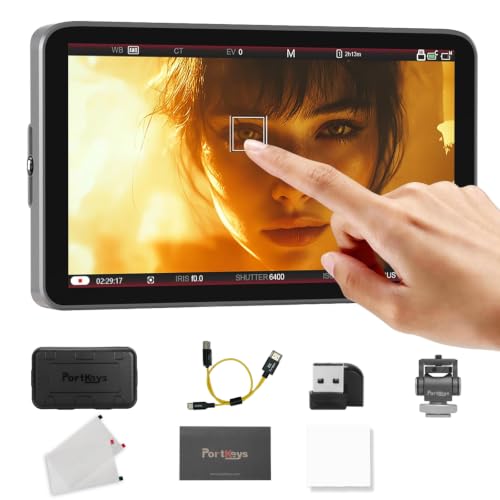
The Portkeys LH7C is a 7-inch field monitor for cameras from Sony, Canon, and Panasonic. Its 1000-nit IPS screen should remain readable in many bright outdoor setups, while the 245g engineering-plastic body keeps weight down on cages and gimbals. It accepts power from an NP-F battery or a 7-24V DC source, but the battery is not included. A USB-A port handles firmware updates and LUT files, and the 1/4″-20 threads support common mounting arms.
Its strongest feature is wired touchscreen control with supported cameras. The included TA03Y cable carries video and control through one 2.5mm connection, reducing cable clutter. The monitor accepts 4K 30p input, then downsamples it to 1080p for display. Its 10-bit, 8+2 FRC panel supports smoother color transitions, and you can load up to 20 custom 3D LUTs. HDMI LUT output can send the graded feed to another monitoring device. Freeze-frame overlays help match positions between takes, while anamorphic presets cover 1.00x to 2.35x, with custom adjustment from 0.25x to 4.00x.
Pros
- 1000-nit brightness suits many daylight shooting situations.
- Wired touchscreen control works with numerous listed Sony, Canon, and Panasonic cameras.
- Freeze-frame overlays and 20 LUT slots support continuity and color workflows.
Cons
- Camera control depends on model compatibility and the included wired connection.
- The screen displays 4K input at 1080p, and an NP-F battery must be purchased separately.
5. Portkeys LH7C Camera Field Monitor

Best for: Camera crews needing wired monitor control
The Portkeys LH7C is a 7-inch field monitor priced at $249. Its IPS display reaches 1,000 nits and uses 10-bit color through 8+2 FRC processing. It accepts 4K 30p input, then downsamples it to 1080p for display. Supported Sony, Canon, and Panasonic cameras can use touchscreen controls through the included TA03Y HDMI control cable.
This monitor offers useful tools for set work. You can load up to 20 custom 3D LUTs through USB and send the LUT-processed signal over HDMI to another monitor or wireless transmitter. A USB drive can store reference frames for transparent overlay comparisons. The anamorphic tool includes 10 presets and manual adjustment from 0.25x to 4.00x. At 245g, the high-density plastic body suits cages and gimbals. It accepts NP-F batteries or 7-24V DC power, but no battery comes in the box.
Pros
- Touchscreen camera control works with many Sony, Canon, and Panasonic models.
- HDMI LUT output helps match the director’s or crew monitor to the camera view.
- Frame overlays support continuity checks and repeatable shot composition.
Cons
- The 1080p display does not show 4K input at native resolution.
- Wired control depends on a compatible camera and the included cable, while battery power costs extra.
4. Lilliput A5 Camera Field Monitor
Best for: Mobile DSLR and mirrorless shooters
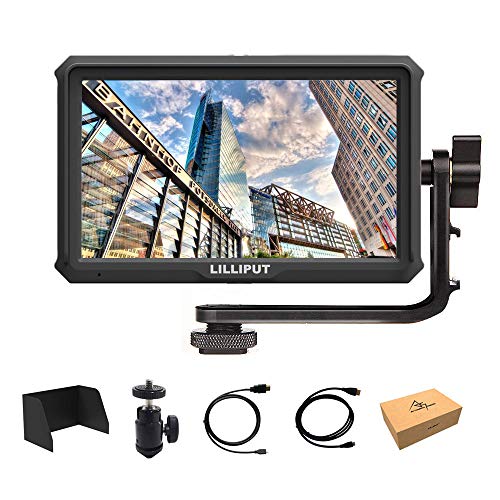
The Lilliput A5 is a compact 5-inch field monitor for cameras with HDMI output. Its 8-bit IPS LCD shows a native 1920 x 1080 image at 441 pixels per inch. The panel has a 16:9 aspect ratio, 400 cd/m² brightness, a 1000:1 contrast ratio, and a 170-degree viewing angle. It accepts UHD 4K signals, then displays them in Full HD.
The main advantage is its mix of sharp detail and production tools in a small body. Peaking can help confirm focus, while false color assists with exposure checks. An audio level meter gives a quick view of incoming sound. You can assign functions such as peaking, underscan, and check field to shortcut buttons. The control dial adjusts sharpness, saturation, tint, and volume. HDMI output also lets the monitor pass a signal to another display or device. Included cables cover standard DSLR connections, but Panasonic GH5 users need to buy an HDMI-to-HDMI cable separately. At $169, it fits shooters who need more camera feedback without carrying a larger monitor.
Pros
- Full HD resolution on a 5-inch, 441ppi IPS panel provides a detailed framing view.
- 4K HDMI input supports signals up to 3840 x 2160 at 30Hz.
- Peaking, false color, and audio meters support focus, exposure, and sound checks.
Cons
- The small 5-inch display can feel cramped for reviewing fine focus or composition.
- The included cables do not work with the Panasonic GH5, so that camera requires a separate HDMI-to-HDMI cable.
3. NEEWER F700 7-Inch Camera Field Monitor

Best for: DSLR video crews
The NEEWER F700 is a 7-inch camera field monitor for DSLR and mirrorless video setups. Its 1920 x 1080 IPS display reaches 2000 nits, so the image should remain visible in bright outdoor scenes. Manual and automatic backlight control cover levels 1 through 100. A 180° adjustable bracket, 160° viewing angle, and touch or button controls add mounting and handling flexibility.
This monitor accepts and loops HDMI signals up to 4K, while the screen itself displays Full HD. Tools include waveform, vectorscope, histogram, false color, zebras, HDR, and focus peaking. It includes 15 LUTs and supports up to 60 custom LUT files through an SD card. Two 4400mAh NP-F750 batteries provide a listed 4.8 hours of combined runtime. The unit measures 6.9 x 4.2 x 1 inch and weighs 30.2 ounces with both batteries.
Pros
- 2000-nit brightness and automatic backlight control suit outdoor shoots.
- HDMI loop-through supports up to 4K input and output.
- Two NP-F750 batteries and a USB-C cable come included.
Cons
- The monitor weighs 30.2 ounces with batteries, adding noticeable weight to a camera rig.
- Headphones, an SD card, and the DC power cable are not included.
2. NEEWER F100 Camera Field Monitor

Best for: DSLR filmmakers needing a larger monitor
The NEEWER F100 is a 7-inch external camera monitor for DSLR, mirrorless, and camcorder setups. Its IPS display has a 1280 x 800 resolution, 450-nit brightness, 1200:1 contrast ratio, and 16:10 aspect ratio. The slim 17mm body keeps the monitor relatively compact on a rig. It accepts several HDMI video formats, including 1080p at up to 60 frames per second, but the panel itself does not display a full 1920 x 1080 image.
Its strongest feature is the set of built-in filming tools. Peaking can help with manual focus, while histogram, safe-frame guides, pixel-to-pixel viewing, image flip, freeze, and custom color temperature controls give filmmakers more control than a camera screen alone. The included 4400mAh F750 battery provides up to 3.5 hours of stated runtime. USB power input can extend use from a power bank or computer. A 360-degree ball head, two HDMI cable types, and a sunshade come in the box, making setup easier across different cameras.
Pros
- 7-inch IPS screen gives a larger viewing area than most built-in camera displays.
- Focus peaking, histogram, and safe-frame markers support more accurate framing.
- Includes a battery, ball head, sunshade, and HDMI-to-micro and HDMI-to-mini cables.
Cons
- The 1280 x 800 panel is lower resolution than a true 1080p monitor.
- The battery lasts up to 3.5 hours, so longer shoots may need USB power or a spare battery.
1. FEELWORLD F5 Prox Camera Monitor

Best for: Outdoor DSLR and mirrorless filming
The FEELWORLD F5 Prox is a 5.5-inch external monitor for DSLR, mirrorless, and cinema cameras. Its 1600-nit display gives you a larger, brighter view than most built-in camera screens, which helps with framing, focus, and exposure in outdoor locations. The touchscreen provides direct access to monitor controls, while standard mounting points support camera cages, rigs, tripods, gimbals, and handheld setups.
What sets this monitor apart is its focus and exposure assistance. Focus peaking can make sharp edges easier to spot, while the waveform, histogram, and false-color tools provide more useful exposure information than the camera screen alone. It also offers LUT preview for Log footage, so you can view a closer approximation of the finished look during recording. At $169.99, it targets creators who need stronger on-set visibility without moving to a larger production monitor.
Pros
- The 1600-nit screen remains easier to view in direct sunlight than a typical camera display.
- Focus peaking, waveform, histogram, and false color support more controlled focusing and exposure.
- The 5.5-inch size fits camera rigs and gimbals without the bulk of a larger field monitor.
Cons
- A 5.5-inch screen still cannot match the viewing area of a tablet-sized production monitor.
- An external display adds another device to mount, power, and protect during a shoot.
Buying Guide
HDMI compatibility matters most when choosing a monitor for the Panasonic GH5. The camera uses a full-size HDMI Type A port, so the display must accept the camera’s resolution and frame-rate output without extra adapters.
- Signal support: Choose a monitor that accepts 4K HDMI input at your planned frame rates. Confirm it can display the GH5’s 4K output, not just 1080p.
- Screen size and brightness: A 5- to 7-inch screen fits most rigs. For outdoor filming, look for at least 1,000 nits, while 400 to 500 nits suits indoor work.
- Monitoring tools: Prioritize focus peaking, zebras, waveform, false color, and a histogram. A 3D LUT preview also helps when recording flat picture profiles.
- Power options: Select a model using common NP-F or LP-E6 batteries, depending on your kit. Dual battery slots can extend shooting time and reduce swaps.
- Build and mounting: Check for a 1/4-20 mounting thread, a sun hood, and a metal frame. Keep total monitor weight near 12 ounces or less for handheld rigs.
If you cannot have everything, prioritize reliable HDMI compatibility, since an advanced display is useless without a stable picture.
Frequently Asked Questions
How do I choose the best field monitor for a GH5?
The best field monitor for a GH5 is one with a bright 5- to 7-inch display, HDMI input, focus aids, and a battery system that fits your shooting style. For handheld work, a 5-inch unit usually adds less bulk, while a 7-inch screen gives more room for waveform and focus tools.
What features should a GH5 camera monitor have?
A GH5 camera monitor should offer waveform, false color, focus peaking, zebra patterns, and a clear HDMI connection. A 1,000-nit or brighter display remains easier to view outdoors than a dimmer panel, but a sun hood can still help under direct midday light.
Can I use any external monitor with a Panasonic GH5?
You can use an external monitor with a Panasonic GH5 through its full-size HDMI Type A output, provided the monitor accepts the camera’s selected signal. For a 4K setup, confirm support for the chosen resolution and frame rate before buying, since not every inexpensive screen handles every HDMI format.
Are budget field monitors good enough for the GH5?
Budget field monitors can work well with the GH5 when they include reliable HDMI input, basic exposure tools, and a suitable battery mount. Models under $100 may provide a 5-inch display, but they often have dimmer screens, slower menus, or fewer monitoring aids than midrange options.
Conclusion
FEELWORLD F5 Prox Camera Monitor remains the top recommendation for GH5 owners who want a compact on-camera screen for checking focus, exposure, framing, and recording setup during travel, documentary, or small studio work. If your main priority is the lightest possible rig, choose a smaller display instead, because it will take up less space on a cage and place less strain on a handheld or gimbal setup. Before buying, double-check the monitor’s physical size, HDMI compatibility with the GH5 and your other devices, the quantity of included cables, batteries, or mounting parts, and the current price, since package contents can vary between sellers.
