
7 Best Kodak Slide Projector Picks for Home Use
The Kodak BC4401 Carousel 4400 Projector is the best kodak slide projector for most buyers because its carousel format keeps slide changes organized and straightforward. It is a practical choice for family archives, classroom presentations, and home viewing. The design suits buyers who want a traditional Kodak projector rather than a digital display or scanning device.
This guide is for anyone comparing vintage slide projectors for occasional viewing or regular presentations. Pay close attention to the unit’s size, tray capacity, lens condition, bulb availability, and power requirements. Older models can vary widely in storage needs and replacement-part costs. The 7 picks below are ranked by their useful features, expected fit, and overall practicality, with clear reasons and honest drawbacks for each. That makes it easier to choose a model that matches your slide collection, room, and budget.
Quick Comparison
| # | Product | Best For | Price | |
|---|---|---|---|---|
| 1 | Kodak BC4401 Carousel 4400 Projector | Best for casual slide presentations | $229.00 | View → |
| 2 | Kodak Carousel 4200 Slide Projector | Best for home photo archives | $219.70 | View → |
| 3 | Kodak 760H Carousel Slide Projector | Best for classroom slide lessons | $215.00 | View → |
| 4 | Kodak Carousel 5200 Projector | Best for large slide collections | $219.77 | View → |
| 5 | Kodak 35mm Slide & Film Viewer | Best for quick film inspection | $39.99 | View → |
| 6 | KODAK Slide N Scan Film & Slide Scanner | Best for digitizing 35mm memories | $189.99 | View → |
| 7 | Kodak Carousel 4400 Projector | Best for vintage carousel enthusiasts | $195.00 | View → |
7 Kodak Slide Projectors Worth Considering
The list is ranked by image quality, ease of use, and value, counting down to the top pick.
7. Kodak Carousel 4400 Projector

Best for: Home slide-show collectors
The Kodak BC4404 Carousel 4400 is a film-slide projector for displaying carousel-mounted slides on a larger screen or wall. At $195, it targets buyers who still own compatible slide collections and want a dedicated machine instead of a digital replacement. Its remote controls three key functions: advancing, reversing, and focusing the image. That makes it easier to manage a presentation from a chair.
Its 3-position lamp switch adds useful control. The off setting shuts the unit down, fan runs cooling without the lamp, and lamp activates projection. A rear leveling foot helps compensate for uneven tables, while the accessory outlet can power a connected device. Kodak also lists improved corner-to-center illumination, which should help keep slide brightness more consistent across the frame. The main appeal is practical control for traditional slides, not modern connectivity.
Pros
- Remote control handles forward, reverse, and focus adjustments.
- Three lamp settings separate projection from fan cooling.
- Rear leveling foot helps position the image on uneven surfaces.
Cons
- It is designed for film slides, not HDMI, USB, or wireless video.
- Buyers must already have compatible slide trays and collection materials, which can add cost if they are missing.
6. KODAK Slide N Scan Film & Slide Scanner

Best for: Digitizing mixed-format family archives
The KODAK Slide N Scan converts 35mm, 110, and 126mm negatives, plus 50mm slides, into 22MP digital files. It includes holders and adapters for each listed format, along with a cleaning brush, USB cable, and HDMI cable. Files save directly to an SD or SDHC card up to 32GB, but the card is sold separately. At $189.99, this is aimed at home users who want a straightforward way to preserve older film.
Its 5-inch LCD gives you a clear preview before saving, and gallery mode lets you browse stored images without another device. Basic controls handle color, brightness, size, and date or time details. The quick-feed tray supports a steady scanning rhythm, so you can move through a box of negatives without dealing with complex menus. A Type-C USB connection works with compatible computers, while HDMI supports display connections. The screen can also show stored pictures around the home or office, although it is not a substitute for a dedicated photo display.
Pros
- Supports 135, 110, and 126mm film, plus 50mm slides.
- Creates 22MP files for larger digital copies.
- Built-in 5-inch screen supports previews, editing, and gallery viewing.
Cons
- SD or SDHC storage is required, and no card comes included.
- Basic one-touch editing may feel limited for users who need detailed restoration tools.
5. Kodak 35mm Slide & Film Viewer
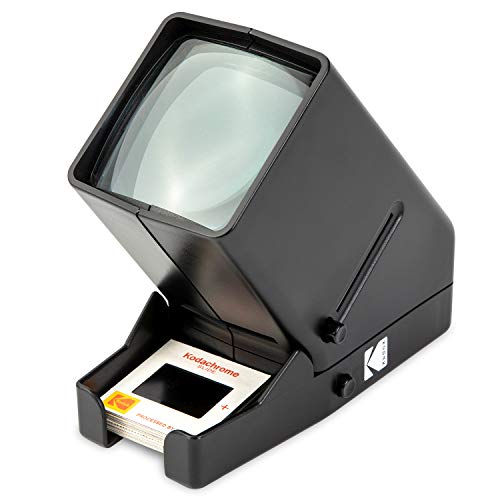
Best for: Families sorting old 35mm memories
The Kodak 35mm Slide & Film Viewer is a handheld tool for old mounted slides and strips of 35mm negative film. It uses an LED light source behind the viewing area, so you can inspect each frame without a separate light box. A built-in lens enlarges images 3x, making small details easier to see. This is a viewer, not a scanner, so it does not create digital files.
Loading is straightforward. Place a slide in the dedicated slot or feed a negative into the film input, then press the quick-eject button to remove it. The daylight-style LED is designed to show colors and contrast clearly, though results depend on the condition of the original film. Battery operation makes it useful away from a desk. It can also run from DC power, but the cable is sold separately. At $39.99, it suits occasional home sorting better than professional film work.
Pros
- 3x magnification makes small slide and negative frames easier to inspect.
- LED backlighting provides a bright viewing area without a separate light box.
- Dedicated inputs and quick ejection speed up sorting through film.
Cons
- It only displays images and cannot scan or convert them into digital files.
- The battery type and runtime are not specified, and the DC cable costs extra.
4. Kodak Carousel 5200 Projector

Best for: Home slide shows and collectors
The Kodak Carousel Projector 5200 is a slide projector designed for viewing mounted photographic slides at home. Its built-in viewing screen gives you a self-contained way to preview images without setting up a separate projection surface. At $219.77, it targets buyers who want a dedicated Kodak carousel unit rather than a modern digital projector.
Its automatic focus is the strongest convenience feature. The projector can adjust the image without requiring constant manual correction during a slide show. A 102mm f/2.8 lens also gives the optical system a relatively bright aperture for slide projection, while the fixed lens length keeps the setup straightforward. The built-in screen adds flexibility for quick previews, family photo sessions, or checking slides before displaying them to a larger audience. Still, the available details do not state the screen size, supported slide capacity, brightness, or image resolution. Buyers should confirm those points before paying this price, especially if they expect large, detailed projections.
Pros
- Automatic focus reduces manual adjustment between slides.
- The 102mm f/2.8 lens provides a bright optical setup.
- Built-in viewing screen allows previews without separate equipment.
Cons
- The screen size, brightness, and slide capacity are not specified.
- At $219.77, it may cost more than a basic used slide viewer.
3. Kodak 760H Carousel Slide Projector

Best for: Home slide shows and collectors
The Kodak 760H Carousel is a traditional slide projector for displaying physical photographic slides. It comes with a zoom lens, a slide tray, and a carrying case. At $215, it targets buyers who need a complete presentation setup rather than a bare projector body. The tray helps organize slides during a show, while the case makes storage and transport easier.
Its main appeal is the familiar carousel design and adjustable zoom lens. That combination can suit family archives, classroom presentations, or photography collections where digital files are not the source material. The included accessories also reduce the need to find separate storage or presentation parts. Still, the available feature details do not list the tray’s slide count, the lens’s zoom range, lamp life, or supported slide formats. Those missing specifications matter when comparing this projector with other used models. Buyers should confirm condition and compatibility before paying $215, especially if the unit is older or sold secondhand.
Pros
- Zoom lens gives users more control over image size and placement.
- Included slide tray keeps physical slides organized during presentations.
- Carrying case protects the projector during storage and transport.
Cons
- It works with physical slides, not modern digital presentation files.
- The listing omits key details such as tray capacity, zoom range, and lamp life.
2. Kodak Carousel 4200 Slide Projector

Best for: Home slide shows with existing lenses
The Kodak Carousel 4200 is a film slide projector priced at $219.70. It is designed for users who already own a compatible lens, since the projector does not include one. That missing part affects the real purchase cost and setup time. Buyers should confirm lens compatibility before ordering.
Remote controls handle forward and reverse slide movement, so you can change images without walking to the unit. Kodak also lists improved corner-to-center illumination, which should help spread light more evenly across the projected frame. A long-life lamp may reduce replacement frequency, though no lamp-hour rating is provided. The built-in handle makes the projector easier to carry between rooms, while the accessory outlet can power another presentation device. Its design fits occasional home viewing, classroom use, or archiving sessions where physical slides remain the source material.
Pros
- Remote forward and reverse controls let you change slides from a distance.
- Improved illumination aims to keep the image brighter toward the corners.
- A built-in handle and accessory outlet support easier room-to-room setup.
Cons
- The lens is not included, so buyers need a compatible lens before use.
- No lamp lifespan in hours is listed, making replacement planning difficult.
1. Kodak BC4401 Carousel 4400 Projector

Best for: Slide-show collectors and families
The Kodak BC4401 Carousel 4400 is a $229 slide projector for traditional slide presentations. Its remote handles three useful tasks: moving slides forward, moving them backward, and adjusting focus. A rear leveling foot helps steady the image on an uneven table. The accessory outlet can also power compatible presentation equipment nearby.
The biggest detail to understand is the missing lens. Kodak does not include one, so this is not a ready-to-project package, and the final setup cost will rise after buying a compatible lens. A three-position switch keeps basic operation clear: off, fan-only cooling, or lamp. Kodak also specifies improved illumination from the center toward the corners. That may produce more even brightness, but results will still depend on the lens, lamp, and slide condition.
Pros
- Remote focus and slide-direction controls let the presenter stay seated.
- Fan-only operation provides cooling without powering the lamp.
- A leveling foot and accessory outlet simplify table setup.
Cons
- No lens is included, so an extra purchase is required before projection.
- No digital inputs or brightness controls are listed, limiting modern presentation use.
Buying Guide
The most important factor is compatibility with your slides and tray. Kodak models vary by format, tray design, and lamp system, so a mismatch can make the projector unusable.
- Slide format: Confirm support for standard 35mm mounted slides, usually 2-by-2-inch frames. Do not assume an older unit accepts 110 or 126 film.
- Tray capacity: Choose an 80-slide tray for short presentations or a 140-slide tray for lectures, family archives, and classroom programs. Check that the tray is included.
- Lens and room size: An 85mm lens suits shorter throw distances, while a 100mm to 135mm lens fits larger rooms. Measure the screen distance before buying.
- Lamp availability: Verify the exact replacement lamp number and wattage. A projector with easy-to-find bulbs is safer than one requiring rare lamps, which can cost $20 to $60 each.
- Condition and price: For used equipment, expect roughly $50 to $250, depending on the lens, tray, case, and working condition. Favor listings that show the fan, slide advance, focus, and power cord.
If you cannot have everything, prioritize format and tray compatibility because other features cannot fix an unsuitable feed system.
Frequently Asked Questions
How do I choose a Kodak slide projector for home use?
Choose a Kodak slide projector with the correct slide format, a working lamp, and a compatible lens for your room size. Most models use 35mm slides, but some older units need different trays or mounts. Check the model number, tray type, bulb availability, and focus mechanism before buying.
What features matter most in a Kodak slide projector?
The key features are slide-format compatibility, tray capacity, lens condition, focus control, and lamp availability. A carousel model may hold 80 or 140 slides, depending on the tray. Look for smooth tray movement, a clear lens, a complete remote, and a power cord without damaged insulation.
Can I still find replacement bulbs for these slide projectors?
Yes, replacement bulbs are still available for some Kodak projectors, but compatibility depends on the exact model and lamp code. Search the projector manual or label before ordering. For example, a bulb listed for one Kodak Carousel model may not fit another projector with a similar appearance.
Are Kodak slide projectors worth buying today?
Kodak slide projectors can be worth buying for occasional viewing, but they are less practical than digital displays for frequent presentations. Prices depend on condition, accessories, and lamp supply. A complete unit with its tray, lens, remote, and manual is usually a safer purchase than a projector sold as untested.
Conclusion
The Kodak BC4401 Carousel 4400 Projector remains the top choice for buyers who want a familiar Kodak carousel format for family slides, school presentations, or occasional home viewing. If your priority is easier storage or a simpler setup, choose a more compact slide viewer instead, especially when you do not need a full carousel tray or room-filling projection. Before buying, double-check the projector’s size, slide compatibility, included tray or carrier, bulb condition, accessory quantity, and current price, since older Kodak equipment can vary widely by seller. Also confirm that the listing shows the exact BC4401 model, not a similar-looking Carousel unit with different controls or included parts. That small check can prevent an expensive mismatch.
