
6 Best Mechanical Keyboard for Small Hands for Gaming
AULA F75 Pro Wireless Mechanical Keyboard is the top pick for most buyers seeking the best mechanical keyboard for small hands. Its compact 75% layout keeps the desk footprint small while retaining arrow keys and a full function row. That balance gives shorter reach between common controls without forcing you to learn an unusually stripped-down layout. It also suits work, gaming, and everyday typing.
This guide is for shoppers who find full-size keyboards too wide or uncomfortable for shorter reaches. The key factors are overall width, key spacing, switch feel, and connection options, since these affect hand movement during long sessions. Battery life matters for wireless models, while sturdy construction helps a compact board stay steady. The six picks below are ranked with clear reasons and honest drawbacks for each, so you can compare layouts before choosing a smaller keyboard.
Quick Comparison
| # | Product | Best For | Price | |
|---|---|---|---|---|
| 1 | AULA F75 Pro Wireless Mechanical Keyboard | Wireless Setup Seekers | — | View → |
| 2 | Redragon Wired Mechanical Gaming Keyboard | Budget-Conscious PC Gamers | $29.99 | View → |
| 3 | Aula WIN60 HE Mechanical Gaming Keyboard | Competitive FPS Players | $37.61 | View → |
| 4 | Guiheng 60% Mechanical-Feeling Gaming Keyboard | First-Time Mechanical Keyboard Buyers | $13.99 | View → |
| 5 | Snpurdiri 60% Wired Mechanical Keyboard | Compact Desk Setup Owners | $26.00 | View → |
| 6 | One-Handed Wired Gaming Keyboard | Left-Handed Gaming Keypad Users | $17.00 | View → |
6 Mechanical Keyboards for Smaller Hands
This ranked list counts down from sixth place to the top pick, with compact layouts and fit guiding each recommendation.
6. One-Handed Wired Gaming Keyboard
Best for: FPS players with limited desk space
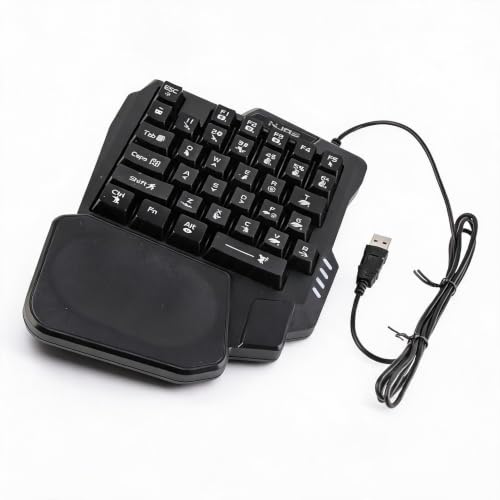
This $17 one-handed gaming keyboard uses a compact 35-key layout for PC, laptop, Windows devices, and some Android tablet setups. Its wired USB connection avoids battery charging and helps keep input timing consistent. The angled chassis includes a detachable palm rest, while rubber feet help limit movement during play. Its small footprint also suits dorm desks, laptop stations, and LAN events.
The tactile mechanical switches provide clear feedback for quick commands in FPS, MOBA, and RPG games. RGB lighting offers preset effects and programmable zones, which can improve visibility in a dim room. The keyboard also supports on-the-fly macro assignments, according to the product description. Its strongest feature is the focused layout. You get commonly used game controls without giving up mouse space, though the design requires a separate keyboard for normal typing. The product claims zero ghosting and switches rated for millions of clicks, but it does not identify the switch brand or exact lifespan rating. At $17, it offers a low-cost way to test a left-hand control pad.
Pros
- 35 keys leave more room for precise mouse movement.
- Detachable palm rest supports a more natural wrist position.
- Wired USB connection needs no battery or driver installation.
Cons
- The 35-key layout cannot replace a full keyboard for chat, browsing, or office work.
- RGB controls and macro features may require learning the included key combinations, since no dedicated software is listed.
5. Snpurdiri 60% Wired Mechanical Keyboard

Best for: Compact gaming and typing setups
The Snpurdiri 60% keyboard is a small wired mechanical model for desks with limited room. Its compact layout leaves more space for a mouse, notebook, or other gear. The detachable USB-C cable also makes storage and transport easier than a permanently attached cable. At $26, it targets shoppers who want mechanical keys without paying for a larger premium board.
Red switches give the keys a light, quick feel. They suit fast gaming inputs and ordinary typing, though sensitive switches can also register accidental presses. The rainbow LED backlight adds color during evening use, but the listing does not describe brightness levels or lighting controls. Two adjustable feet let you change the keyboard’s angle to match your setup. It works with Windows XP, Windows 7, and Windows 10, according to the product details. Since it is a wired board, it avoids battery charging, but it still needs a USB connection whenever you use it.
Pros
- Compact 60% layout frees up valuable desk space.
- Red mechanical switches require less force and respond quickly.
- Detachable USB-C cable makes packing and cable replacement simpler.
Cons
- The 60% layout sacrifices dedicated keys found on full-size keyboards, including a number pad and separate function row.
- Rainbow lighting may not suit buyers who want simple single-color illumination or detailed lighting controls.
4. Guiheng 60% Mechanical-Feeling Gaming Keyboard

Best for: Budget-conscious compact desk setups
This Guiheng keyboard is a wired 68-key option for Windows PCs, Macs, laptops, and several other systems, including Android, Linux, iOS, PS4, and PS5. Its compact layout leaves more room for a mouse or notebook, while the included USB cable supports plug-and-play use. Rainbow RGB backlighting adds visibility in dim rooms, though the listing does not specify brightness levels or lighting controls.
The red switches aim to provide a mechanical-style feel with crisp feedback and a loud click. All 68 keys are described as conflict-free, so multiple presses can register together during games or shortcuts. Ten multimedia keys add quick controls for common functions. The keycaps use double-shot injection molding and a non-slip suspended design, while a splash-proof panel offers some protection from minor spills. Adjustable kickstand feet let you change the typing angle. At $13.99, its feature count is appealing, but the product description does not confirm a true mechanical switch design or provide a rated key lifespan.
Pros
- Compact 68-key layout saves desk space and travels easily.
- Conflict-free input supports simultaneous key presses for gaming.
- Splash-resistant construction and double-shot keycaps suit regular use.
Cons
- Loud clicking may disturb nearby coworkers, roommates, or family members.
- Wired-only operation limits placement and adds cable clutter.
3. Aula WIN60 HE Mechanical Gaming Keyboard

Best for: FPS players with small desks
The AULA WIN60 HE is a wired, 60% mechanical gaming keyboard built around Hall Effect magnetic switches. Its compact layout removes the function row, navigation cluster, and number pad, leaving more room for a mouse. The switches are hot-swappable, and adjustable actuation lets you choose when a key registers. A rapid trigger setting can respond to movement changes as small as 0.02mm, according to the listed specifications.
Its 8000Hz polling rate targets fast input for games such as Valorant and CS2. The lower-positioned RGB lighting shines through the PBT keycaps, with up to 16.8 million color options. Customization runs through a web-based driver, so you can remap keys, create macros, and adjust lighting without installing desktop software. At $37.61, it packs advanced controls into a low-cost format. Still, the small layout requires shortcuts for several everyday keys, and the wired design will not suit users who want a wireless setup.
Pros
- Hall Effect switches support adjustable actuation and rapid trigger control.
- 8000Hz polling targets quick input in competitive FPS games.
- Hot-swappable switches and web-based controls allow key and macro customization.
Cons
- The 60% layout lacks dedicated arrow keys, function keys, and a number pad.
- The wired connection limits placement and adds another cable to the desk.
2. Redragon Wired Mechanical Gaming Keyboard

Best for: Budget PC and Mac gamers
The Redragon K671 is a wired mechanical keyboard for people who want programmable controls without spending much. At $29.99, it uses linear red switches with a lighter, smoother press that fits fast games and long typing sessions. The switches are hot-swappable, and the box includes four spare switches plus two red replacement keycaps. That gives you a simple repair path if a switch fails.
Its backlight offers 11 preset effects, five brightness levels, and adjustable speed. The lighting color cannot be changed, so this is not an RGB keyboard with unlimited color choices. Macro software lets you remap keys, create shortcuts, and combine functions, which can help with repeated work or game commands. All keys support anti-ghosting, and 12 shortcuts cover volume, media, email, and the calculator. The keycap materials need a closer look: the product name says double-shot PBT, while the feature details identify double-injection ABS. Check the seller’s final specification before buying. Redragon lists a 24-month warranty.
Pros
- Hot-swappable red switches allow replacement without changing the whole keyboard.
- Eleven lighting modes, five brightness levels, and speed control offer useful night-time adjustment.
- Full-key anti-ghosting supports simultaneous key presses for complex commands.
Cons
- The backlight color is fixed, despite adjustable effects and brightness.
- The listing gives conflicting keycap materials, PBT in the title and ABS in the feature details.
1. AULA F75 Pro Wireless Mechanical Keyboard

Best for: Compact wireless gaming and office setups
The AULA F75 Pro is an 81-key, 75% mechanical keyboard that keeps arrow keys while using less desk space than a full-size model. It supports Bluetooth 5.0, 2.4GHz wireless, and USB-C wired connections. You can pair up to five devices and switch between them with shortcut keys or the side button. A 4000mAh rechargeable battery supports wireless use, though no runtime figure is provided.
Its strongest feature is the flexible hot-swap design. The socket accepts both 3-pin and 5-pin switches, so you can change the pre-lubed Reaper switches without soldering. Five layers of internal dampening, silicone padding, and single-key PCB slots aim to reduce hollow noise and add a softer feel. Side-printed PBT keycaps use double-shot molding and heat sublimation, while RGB lighting offers 16 preset effects, adjustable brightness, and music-reactive modes through the driver. The knob controls volume or lighting after switching between office and gaming modes.
Pros
- Tri-mode connectivity works with computers, tablets, phones, and consoles.
- Hot-swap sockets accept 3-pin and 5-pin switches without soldering.
- PBT keycaps, five-layer dampening, and pre-lubed stabilizers support quieter, smoother typing.
Cons
- Battery life is not specified, making wireless charging intervals difficult to predict.
- Macro programming and music-reactive lighting depend on the included driver, which may add setup time.
Buying Guide
A compact layout is the most important choice for smaller hands. A 60% or 65% board keeps distant keys closer, reducing finger stretching during long typing sessions.
- Layout size: Choose a 60% board for the smallest footprint, or a 65% model if you want dedicated arrow keys. These layouts usually measure about 11 to 13 inches wide.
- Key reach: Standard mechanical keyboards use roughly 19mm key spacing, so focus on reducing board width rather than chasing unusually narrow keys. Keep frequently used keys within a comfortable 6-inch reach.
- Front height: Look for a case under 1.5 inches tall at the front, or choose an adjustable wrist rest. A steep case can bend smaller wrists upward.
- Switch force: Start with linear or tactile switches rated between 35 and 55 grams. Heavier switches above 60 grams may cause fatigue during eight-hour workdays.
- Connection and price: Wired USB-C models often cost $50 to $100 and avoid battery concerns. Wireless boards commonly cost $80 to $160, with at least 40 hours of rated battery life preferred.
If you cannot have everything, prioritize the 60% or 65% layout, since shorter reaches affect every keystroke.
Frequently Asked Questions
How do I choose a mechanical keyboard for small hands?
Choose a compact mechanical keyboard with a 60% or 65% layout, standard key spacing, and light actuation force. These formats remove the number pad and navigation block, reducing reach between keys. Look for uniform-profile keycaps, such as XDA, if you prefer a flatter feel. A 65% board usually has about 68 switches.
What keyboard size works best for shorter fingers?
A 60% or 65% mechanical keyboard usually works best for shorter fingers because it keeps the primary typing area compact. A 60% model has about 61 keys, while a 65% version typically has 67 to 68 and dedicated arrow keys. Choose 65% for frequent navigation, or 60% for the shortest reach.
Can low-profile mechanical keyboards help with small hands?
Yes, low-profile mechanical keyboards can help small hands by shortening key travel and lowering the overall typing height. Many use switches with roughly 2.5 to 3.2 millimeters of travel, compared with about 4 millimeters on standard mechanical switches. They may feel faster to press, but replacement keycaps and switch choices are often more limited.
Are linear or tactile switches better for smaller hands?
Neither type is universally better, but light linear switches are usually easiest for smaller hands because they offer consistent resistance without a tactile bump. Choose a switch rated around 35 to 45 grams if you prefer a lighter press. Tactile models around 45 to 55 grams can suit typists who want stronger feedback.
Conclusion
The AULA F75 Pro Wireless Mechanical Keyboard is the top pick for shoppers with small hands who want a compact layout, wireless use, and a fuller typing feel without moving to a tiny 60% board. If your priority is the lightest, simplest setup, choose a smaller 60% or 65% model instead, since its reduced width can keep keys within easier reach. Before buying, double-check the keyboard’s exact size, operating-system compatibility, package quantity, and current price, since listings and bundles can change. Also confirm the key layout matches your habits, especially if you use arrow keys, function-row shortcuts, or a number pad. A comfortable fit matters more than extra lighting or software features.
