
6 Best Microscopes for Geology for Thin Sections
For most buyers, the Carson MicroFlip MP-250 Pocket Microscope is the best microscope for geology because its compact handheld design makes field viewing easy. This small scope provides built-in lighting and up to 250x magnification, so you can inspect mineral grains, rock textures, and crystal edges without carrying a full-size instrument. Its pocket-friendly format also suits quick checks at collecting sites, in classrooms, or at a workbench. The tradeoff is a smaller viewing area than many tabletop microscopes, which can make detailed comparisons slower.
This guide is for rock collectors, students, field geologists, and anyone examining mineral samples at home. For this category, the key factors are useful magnification, clear lighting for opaque specimens, focus control, and a size you can carry comfortably. The six picks below are ranked with specific reasons and honest drawbacks for each.
Quick Comparison
| # | Product | Best For | Price | |
|---|---|---|---|---|
| 1 | Carson MicroFlip MP-250 Pocket Microscope | Field inspection on the go | $19.99 | View → |
| 2 | PalliPartners Compound Microscope | Classroom biology students | $87.95 | View → |
| 3 | Carson MicroBrite Plus Pocket Microscope | Coin and stamp collectors | $14.99 | View → |
| 4 | Skybasic Wireless Digital Microscope | Wireless viewing across multiple devices | $28.46 | View → |
| 5 | Geology Microscope Prepared Slides | Beginner geology slide study | $245.00 | View → |
| 6 | Carson MM-450 Pocket Microscope | Kids exploring backyard specimens | $13.99 | View → |
6 Top Microscopes for Geology
This ranked list counts down from capable entry-level options to the microscope we consider the strongest overall pick.
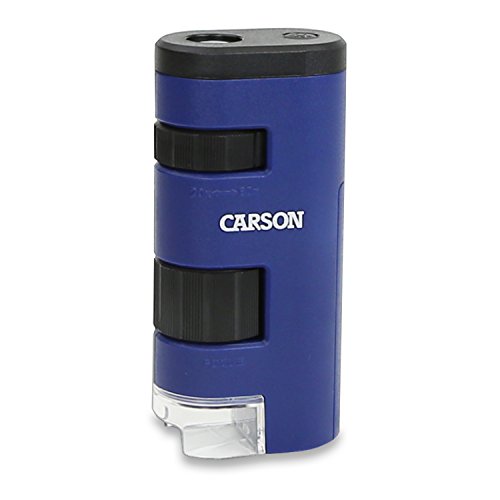
6. Carson MM-450 Pocket Microscope
Best for: Kids exploring everyday objects
The Carson Pocket Micro MM-450 is a handheld microscope for casual STEM discovery. It offers 20x to 60x magnification, giving children a broad view at lower power and closer detail at higher power. That range suits stamps, coins, leaves, fabric, and other small household items. Its compact form fits in a pocket or desk drawer, so it can move from a classroom to the backyard without carrying a full-size microscope.
The built-in LED light helps reveal surface details when room lighting falls short. Simple controls also make the microscope approachable for younger users who may not understand microscope settings yet. At $13.99, it is an inexpensive way to encourage observation and basic science questions. Still, this is a handheld viewer, not a lab instrument. The user must hold it close to the subject and keep it steady, which can make high magnification difficult for small children. It also lacks the stage, slides, and viewing screen found on more advanced microscopes.
Pros
- 20x to 60x magnification works for coins, stamps, leaves, and other small objects.
- Built-in LED lighting improves visibility in dim rooms or outdoor shade.
- Compact handheld design suits classrooms, travel, and backyard exploration.
Cons
- Handheld operation can produce a shaky view, especially at 60x power.
- It is better for surface inspection than prepared-slide microscopy or detailed lab work.
5. Geology Microscope Prepared Slides

Best for: Geology classrooms and teaching labs
This 24-piece set contains prepared mineral thin section slides for microscope-based geology lessons. Each slide uses glass measuring 76.2 × 25.4 mm, with a thickness between 1 and 1.2 mm. The listed specimens are fresh and clear, which should help students examine mineral structures and compare samples during guided activities. The slides are designed as educational microscope accessories rather than general-purpose specimen holders.
The main appeal is the ready-made collection. Preparing mineral thin sections requires specialized equipment, time, and skill, so a prepared set can simplify classroom setup. Twenty-four samples also give instructors enough variety for several lessons, student groups, or comparison exercises. The standard slide dimensions should fit many conventional microscope stages, but buyers still need to confirm compatibility with their equipment. At $245, this is a focused teaching purchase, not a casual slide pack. The listing does not provide specimen names, mineral types, preparation details, or a storage case, so check those points before ordering if your course requires labeled samples or organized storage.
Pros
- Includes 24 prepared mineral thin section slides for group instruction.
- Glass slides use a familiar 76.2 × 25.4 mm format.
- Fresh, clear specimens may make classroom viewing easier.
Cons
- The $245 price is high for a specialized educational accessory.
- The listing does not identify the minerals or include detailed specimen information.
4. Skybasic Wireless Digital Microscope

Best for: children exploring coins, plants, and insects
This $28.46 Skybasic is a small digital microscope for close-up viewing, not a traditional lab instrument. It connects wirelessly to Android or iPhone devices through its own WiFi hotspot, while a USB cable links it to Windows or Mac computers. The package includes the camera, adjustable stand, base, USB cable, and manual. The USB power adapter is not included.
Its 2MP CMOS sensor can save 1920×1080 images through a phone, while computer use is listed at 720P. Eight adjustable LEDs light the subject, and the stated working distance runs from 3 to 60 mm. A button on the microscope captures photos or starts video, with extra controls available in the Max-see app during WiFi use. The compact design suits trips and simple home projects. Still, this is best viewed as a fixed-focus magnifying camera. It can help children inspect leaves, mineral surfaces, fabric, or small objects, but it is not designed for serious biological work.
Pros
- Wireless phone viewing works with Android and iOS devices through the Max-see app.
- Eight adjustable LEDs help illuminate small objects in dim areas.
- The included stand and base support steadier viewing than handheld use.
Cons
- Setup can require app updates, camera permissions, WiFi switching, or disabling a computer’s built-in camera.
- The fixed-focus design and 3-60 mm working range limit precision for professional or detailed specimen analysis.
3. Carson MicroBrite Plus Pocket Microscope

Best for: Portable science lessons and field viewing
The Carson MicroBrite Plus is a compact, handheld microscope with 60x to 120x magnification. Its small, lightweight design fits in a pocket, backpack, or classroom science kit. At $14.99, it offers an inexpensive way to examine prepared slides, leaves, fibers, and other small objects. The adjustable magnification range gives users two viewing levels instead of one fixed setting.
A built-in LED shines light directly onto the specimen. That illumination can make details easier to see in dim rooms or outdoors. Carson says the microscope receives lab testing for magnification accuracy, but results will still depend on proper focus, lighting, and specimen preparation. Its portable format suits short observations and basic STEM activities, though it cannot replace a full-size classroom microscope for detailed lab work. The product information does not list included slides, a case, or other accessories, so buyers should check the package contents before ordering.
Pros
- 60x to 120x magnification works for slides and everyday objects.
- Built-in LED light helps illuminate specimens during viewing.
- Compact, lightweight body fits portable lessons and field use.
Cons
- Handheld use can make high-power viewing harder to keep steady.
- The listing does not confirm included slides, batteries, or storage accessories.
2. PalliPartners Compound Microscope

Best for: Home biology lessons and STEM projects
The PalliPartners Compound Microscope is a student-focused light microscope priced at $87.95. It uses 4X, 10X, and 40X objective lenses, a WF25X eyepiece, and a 2X lens to create stated magnification settings from 100X to 2000X. Glass optics, coarse focus, and fine focus controls support closer examination of cells, plant tissue, and microorganisms.
The kit includes 28 slides: 10 prepared specimens and 18 blanks for homemade samples. A phone adapter and Bluetooth camera shutter let users capture images through the eyepiece. Top and bottom LED lights cover both opaque objects, such as coins, and translucent samples. The included power adapter keeps the setup simple. SGS safety certification adds useful reassurance for supervised use by children and teens, though this remains an educational microscope rather than a professional laboratory instrument.
Pros
- Wide magnification range: The 4X, 10X, and 40X objectives combine with the 25X eyepiece and 2X lens for settings up to 2000X.
- Useful starter package: Ten prepared slides and 18 blank slides provide samples for immediate viewing and basic projects.
- Flexible lighting: Upper and lower LEDs support opaque objects and translucent biological specimens.
Cons
- High settings require patience: At 1000X to 2000X, small focus adjustments and well-prepared samples become more important.
- Some supplies may be needed: The listed kit includes blank slides, but it does not mention coverslips, stains, or a storage case.
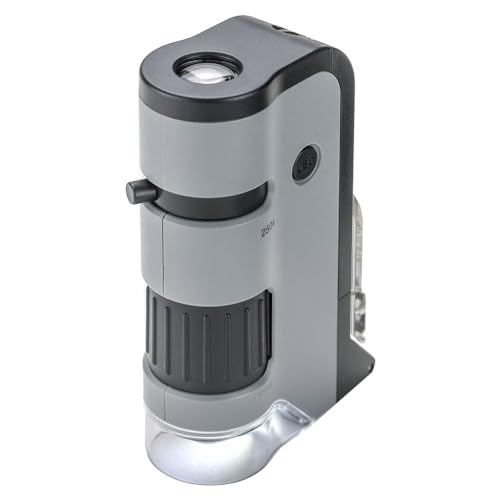
1. Carson MicroFlip MP-250 Pocket Microscope
Best for: Kids’ outdoor STEM discoveries
The Carson MicroFlip MP-250 is a compact pocket microscope with 100x to 250x magnification, LED lighting, and UV illumination. At $19.99, it targets children, students, and educators who want a portable way to inspect prepared samples, plant details, fabric, insects, and other small objects. Its wrist strap supports field trips and backyard exploration, while the lightweight body fits easily in a school bag or pocket.
The included smartphone clip is the main draw. It lets users capture and share microscope views instead of relying only on the built-in eyepiece. Carson also says the lens system reduces distortion for sharper images, which can help when students document observations. Still, this is an educational pocket scope, not a laboratory instrument. The 100x to 250x range suits simple exploration, but samples must sit close to the lens and stay steady. Smartphone alignment may take some adjustment, since phone cameras and cases vary. UV lighting also requires sensible handling around children and eyes.
Pros
- 100x to 250x magnification reveals fine details in samples and small objects.
- LED and UV illumination provide two lighting options for different subjects.
- Smartphone clip supports photos and sharing for school projects or field notes.
Cons
- High magnification has a narrow viewing area and needs careful positioning.
- The phone clip may not fit every smartphone or bulky protective case.
Buying Guide
The most important factor is the useful magnification range. A stereo microscope with 10x to 40x magnification lets you inspect mineral grains, crystal faces, and larger rock textures without losing a three-dimensional view.
- Magnification: Choose 10x to 40x for general rock and mineral work. Select 20x to 80x if you study small crystal edges, inclusions, or fossil details.
- Working distance: Look for at least 3 inches of clearance at your main viewing power. Extra room helps with hand tools and uneven specimens.
- Lighting: Choose adjustable top illumination with LED bulbs rated for roughly 20,000 to 50,000 hours. A lower light adds value for thin sections or translucent minerals.
- Optics and viewing: Use glass eyepieces, binocular viewing, and a 45-degree head when possible. Wide-field eyepieces around 20 millimeters make long sessions more comfortable.
- Stage and accessories: A 3- to 5-inch stage handles most hand samples. A black-and-white plate, rock clips, dust cover, and phone adapter can save $20 to $80 in later purchases. For occasional use, target $150 to $300. Serious hobby work often starts near $400.
If you cannot have everything, prioritize clear optics and a useful 10x to 40x range over extra accessories.
Frequently Asked Questions
How do I choose a microscope for rocks and minerals?
Choose a geology microscope with stereo viewing, adjustable lighting, and enough working distance for your specimens. Look for paired eyepieces around 10x to 20x, then add 2x or 4x magnification when you need closer detail. A stable stand matters for rocks, minerals, and fossils that may weigh several pounds.
What magnification do I need for geology?
Most rock and mineral work needs 10x to 40x total magnification, with a stereo microscope covering the useful range. Start at 10x for crystals, textures, and grain shapes, then move toward 20x or 40x for inclusions and small fractures. Very high powers can narrow the view and reduce working distance, making larger specimens harder to position.
Can I use a biological microscope to examine rocks?
You can use a biological microscope for prepared thin sections, but a stereo model usually suits hand-sized rocks and minerals better. Biological instruments view flat slides with transmitted light, while stereo scopes provide depth and room for uneven samples. For example, a 30-millimeter crystal or rough pebble may not fit comfortably beneath a slide-focused setup.
Are LED lights important on a geology microscope?
LED lighting is useful for geology microscopes because it provides cool, controllable light for reflective specimens. Choose a model with both incident light from above and transmitted light from below if you examine polished sections and translucent minerals. A dimmer helps prevent glare when viewing quartz, calcite, or metallic ore surfaces.
Conclusion
The Carson MicroFlip MP-250 Pocket Microscope is the top pick for rockhounds, students, and field collectors who need a compact, low-cost viewer for quick mineral and texture checks. If your priority is comfortable bench work, greater working distance, or examining larger specimens, choose a full-size stereo microscope instead, since its paired views and broader stage make longer sessions easier. Before buying, double-check the microscope’s folded and working size, confirm that its lighting and phone adapter match your setup, verify the package quantity for replacement slides or accessories, and compare the current price across reliable sellers because bundles and discounts can change the value. This small tool fits portable geology kits best, not every lab bench.
