
6 Best Microscope for Jewelry Making Options for Beginners
The DZQ Jewelers Microscope with Ball Vise is our top pick and the best microscope for jewelry making for most buyers because its ball vise holds small pieces steady while you work. It is a focused jewelry bench microscope, built for close-up viewing and controlled positioning rather than general classroom use. That setup can make soldering, stone setting, inspection, and small repairs easier to manage.
This guide is for hobbyists, students, repair technicians, and bench jewelers choosing a first or replacement optical tool. The key factors are working distance, magnification range, lighting, stand stability, and required bench space. A comfortable viewing angle also matters during long detail work. The 6 picks below are ranked with clear reasons and honest drawbacks for each, so you can compare compact options with more capable bench systems before buying.
Quick Comparison
| # | Product | Best For | Price | |
|---|---|---|---|---|
| 1 | DZQ Jewelers Microscope with Ball Vise | Bench jewelers needing secure stone positioning | $445.99 | View → |
| 2 | CTISMICE Jewelry Microscope | Budget-conscious jewelry repair beginners | $376.99 | View → |
| 3 | VEVOR Multi-Directional Jewelry Microscope | Inspectors needing angled viewing flexibility | $317.44 | View → |
| 4 | DZQ Jewelry Trinocular Microscope | Camera-ready documentation for jewelry workshops | $699.99 | View → |
| 5 | 7X-45X Jewelry Microscope | Detailed gemstone inspection across magnifications | $282.99 | View → |
| 6 | Lakimi 7X-90X Binocular Jewelry Microscope | Wide-range diamond grading professionals | $199.99 | View → |
6 Top Microscopes for Jewelry Work
The list is ranked by viewing clarity, working space, and useful features, counting down to the top pick.
6. Lakimi 7X-90X Binocular Jewelry Microscope
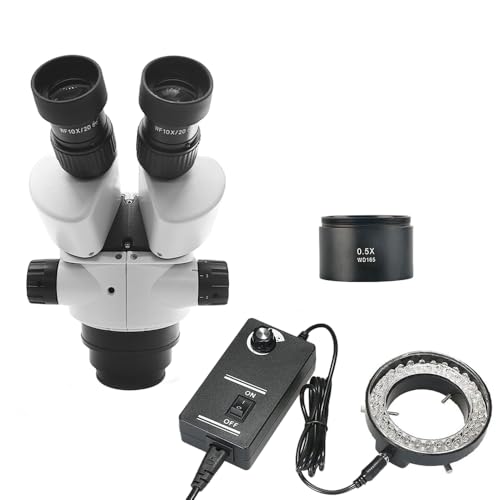
Best for: Jewelry and watch repair benches
The Lakimi White 7X-90X Binocular Jewelry Microscope Head is a stereo viewing unit for detailed bench work. Its continuous zoom range moves from 7X to 90X, giving users room for larger inspection views and close micro-detail work. The 95–300mm working distance, or 3.74–11.81 inches, leaves useful space for setting stones, soldering, engraving, and repairing watches or small electronics.
An adjustable LED ring light adds even illumination around the viewing area, with brightness control for reflective metals and gemstones. The wide-field optical system is designed for sharp images and depth perception. This head also supports a 0.5X Barlow lens and fine-adjustment accessories, which may help when a wider view or more precise focusing is needed. Its heavy-duty metal construction suits a workshop or repair bench. The head fits most standard microscope stands and boom arms, but the product is not a complete microscope setup. A 1-year limited warranty and customer support are included.
Pros
- 7X–90X continuous zoom covers broad inspection and fine detail work.
- The 95–300mm working distance leaves room for tools and handwork.
- Adjustable LED ring lighting helps illuminate small, reflective parts.
Cons
- A compatible stand or boom arm is required, adding cost if you lack one.
- The listed package does not include a camera, so image capture requires separate equipment.
5. 7X-45X Jewelry Microscope
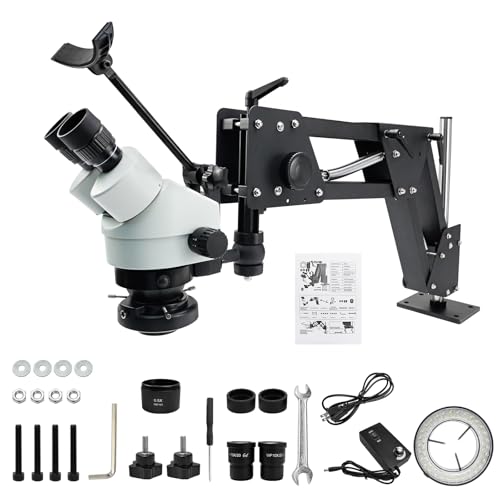
Best for: jewelry setters and engravers
This stereo jewelry microscope combines 7X-45X continuous zoom with a 95-300mm working distance. That range gives users room to position tools, stones, and metal parts beneath the lens. Its high-resolution stereoscopic optics provide depth perception, while the wide-angle view helps keep more of a small work area visible. A 60-ring LED light supplies close-up illumination around the lens.
The spring-arm stand adjusts for different heights, angles, and bench layouts. A telescopic mechanical focus mechanism allows controlled adjustments, and the headrest frame can provide added support during long sessions. The design focuses on detailed setting, inspection, and micro-engraving work rather than general classroom viewing. Treated critical components should help with long-term durability, but the listing does not specify the materials used or provide a service-life estimate. At $282.99, it targets serious jewelry work instead of occasional hobby use.
Pros
- 7X-45X continuous zoom covers broad inspection and fine detail work.
- A 95-300mm working distance leaves space for tools and hand movements.
- The spring arm, mechanical focus, and headrest support flexible bench positioning.
Cons
- The $282.99 price may be high for casual users or occasional inspection.
- Its 7X minimum magnification may feel too strong for larger objects or wide-area viewing.
4. DZQ Jewelry Trinocular Microscope
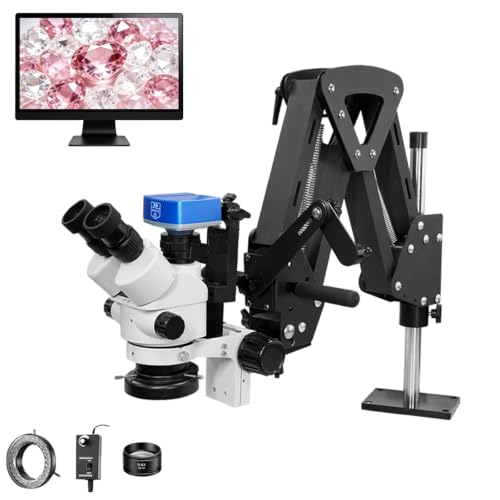
Best for: Jewelry repair and inspection
The DZQ Jewelry Trinocular Microscope combines a 7X–45X continuous zoom system with a 4K camera. Its 95–300mm working distance leaves room for tweezers, pliers, and other tools beneath the lens. The bundle includes two zoom eyepieces, a 0.5X photo eyepiece, an ergonomic stand, a control mouse, and a 60-LED ring light. At $699.99, it targets serious hobbyists, repair benches, and small jewelry businesses.
The camera supports HDMI and USB operation. With HDMI, you can connect a display and use the mouse to capture photos, record video, or take measurements. The two USB ports can handle a mouse and flash drive, allowing direct file storage without a computer. The ring light has a 0–100% dimmer, while the spring bracket, headrest, and mechanical focus support longer inspection sessions. Buyers should still confirm that their display and storage devices match the camera’s connections.
Pros
- The 7X–45X zoom and 95–300mm workspace suit detailed jewelry work with hand tools.
- The 4K camera offers HDMI viewing, USB operation, photo capture, video recording, and measurements.
- The 60-LED ring light provides adjustable brightness from 0% to 100%.
Cons
- The $699.99 price is high for casual users who only need occasional magnified viewing.
- The 7X minimum magnification may feel too strong for larger objects or broad-area inspection.
3. VEVOR Multi-Directional Jewelry Microscope
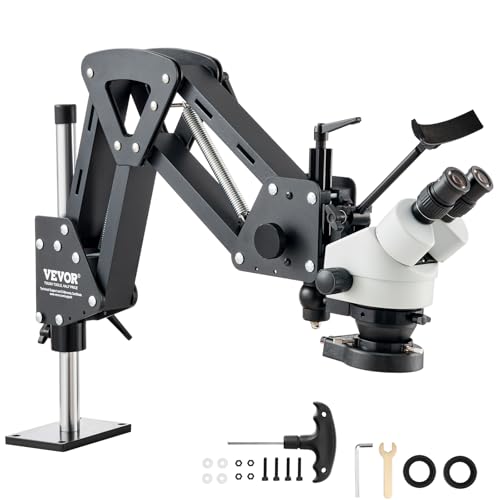
Best for: Jewelry setters needing long reach
This VEVOR stereo microscope is designed for jewelry inlay, stone setting, and other detailed bench work. Its continuous 7X-45X zoom covers both broad inspection and close-up viewing. The listed field of view ranges from 5.1 mm to 33 mm, while the 77 mm lens ring provides room around the viewing area. The operating height adjusts up to 400 mm.
Its reinforced bracket moves vertically, horizontally, and front to back. The working distance ranges from 335 mm to 780 mm, giving this setup more reach than many compact bench microscopes. A quick-release joint lets you loosen, lift, and retighten the support without rebuilding the stand. The integrated ring light uses 144 LEDs and connects through USB. VEVOR lists its output at 18,000 to 35,000 lumens. At $317.44, it offers a specialized setup for users who need positioning flexibility, though the size and price suit a dedicated workstation better than occasional hobby use.
Pros
- 7X-45X continuous zoom supports both general inspection and fine stone-setting work.
- Multi-directional bracket movement and up to 780 mm of working distance provide flexible positioning.
- Integrated 144-LED USB ring light reduces the need for a separate lamp.
Cons
- The long-reach bracket needs substantial bench space and may feel oversized for small work areas.
- High magnification narrows the viewing area to as little as 5.1 mm, which can make larger jewelry pieces harder to inspect at once.
2. CTISMICE Jewelry Microscope
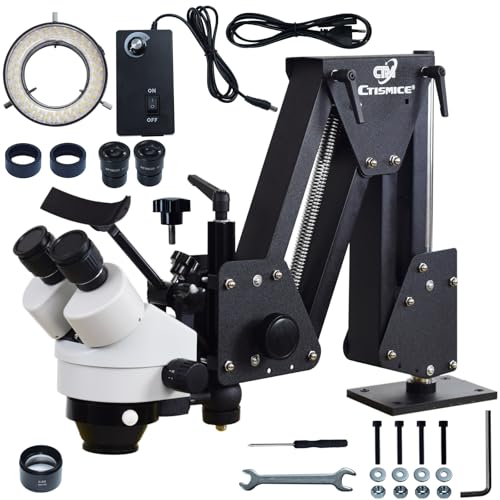
Best for: Bench jewelers setting stones
The CTISMICE Jewelry Microscope is a binocular stereo microscope for diamond setting, jewelry work, watch repair, engraving, and small electronic inspection. Its 7X-45X continuous zoom lets you move from a wider view to detailed close-up work without changing the lens. The head provides a 95mm to 300mm working distance, giving your hands room to position tools and parts.
A flex arm helps place the microscope over a desk, workbench, or counter. The 60-LED ring light attaches to the lens with three metal screws and uses a dimmer for brightness from 0% to 100%. That range should help with bright metals, dark stones, and small circuit boards. The adjustable head and magnifying position can also reduce the need to bend over the work. At $376.99, this is a specialized bench tool rather than a casual magnifier. Buyers should expect to spend a few minutes setting the arm, focus, and working height before switching between projects.
Pros
- 7X-45X zoom covers broad inspection and fine stone-setting work.
- 95mm-300mm working distance leaves room for hand tools.
- Dimmable 60-LED ring light provides focused illumination.
Cons
- The $376.99 price may be high for occasional hobby use.
- Its 95mm-300mm range may not suit every bench setup or project.
1. DZQ Jewelers Microscope with Ball Vise

Best for: Jewelry engraving and micro-setting work
The DZQ Jewelers Microscope pairs a 7X–45X continuous zoom system with a 360° rotatable ball vise. Its $445.99 price targets jewelers who need controlled viewing for small stones, settings, and engraved surfaces. The 95–300mm working distance gives your tools room to reach the workpiece without forcing your hands close to the objective.
A 60-LED ring light supplies adjustable illumination from 0% to 100%, with cold light designed to reduce harsh shadows across the viewing area. Metal lens-mounting screws add a secure attachment point. The spring-mounted support and adjustable headrest should help reduce strain during longer bench sessions, while the mechanical focus provides a more deliberate adjustment than a loose or basic focusing system. The ball vise also lets you rotate a piece to reach different angles without constantly repositioning the entire microscope. Its main limitation is size and purpose. This setup is built for detailed bench work, not general inspection across large objects.
Pros
- The 7X–45X zoom range covers broad inspection and fine detail work.
- A 95–300mm working distance leaves space for engraving tools.
- The dimmable 60-LED ring light offers adjustable, even illumination.
Cons
- The $445.99 price is high for occasional hobby use.
- High magnification can narrow the viewing area and require careful positioning.
Buying Guide
Optical clarity is the most important factor when choosing a jewelry microscope. Clear stereo images reveal tiny scratches, prong gaps, solder joints, and stone inclusions without eye strain.
-
Magnification: Choose a stereo microscope with 5x to 20x magnification. A 10x eyepiece with a 0.5x or 2x auxiliary lens gives useful flexibility for repairs and stone setting.
-
Working distance: Look for at least 4 inches between the lens and workpiece. Around 6 to 8 inches gives better room for tweezers, burs, and soldering tools.
-
Lighting: Select adjustable LED lighting with separate controls for brightness and direction. A ring light helps with general inspection, while a gooseneck lamp reduces shadows inside settings.
-
Stand and focus: Use a boom stand with a 7 to 12-inch reach and smooth coarse and fine focus controls. A stable base should weigh enough to resist movement during detail work.
-
Viewing comfort and price: Binocular eyepieces suit regular bench work, while a trinocular model helps with photos or video. Expect to spend about $200 to $700 for a capable setup, before accessories.
If you cannot have everything, prioritize optical clarity and a comfortable 6-inch working distance over camera features.
Frequently Asked Questions
How much magnification do I need for jewelry work?
A 10x to 20x stereo microscope is enough for most jewelry-making tasks. This range shows prongs, solder joints, stone seats, and small scratches while preserving a useful view of the whole piece. Choose adjustable magnification rather than a fixed 40x lens, which can make hand positioning and tool control harder.
What type of microscope is best for setting stones?
A stereo microscope with binocular eyepieces is the best choice for setting stones because it provides depth perception and leaves both hands free. Look for at least 10 to 15 centimeters of working distance, plus a boom stand that lets you move the optics around a ring, pendant, or loose gemstone.
Can I use a digital microscope for jewelry repair?
Yes, a digital microscope can handle basic jewelry repair, but a stereo model is usually better for hand work. A USB camera can show close details on a monitor, yet screen delay and a narrow viewing angle may hinder soldering or stone setting. Choose one with adjustable LED lighting and at least 1080p output.
Do jewelers need a microscope with a large working distance?
Jewelers do not need a large working distance for every task, but 10 to 20 centimeters makes hand tools easier to use. Shorter distances can work for inspection or engraving with compact tools. For prong setting and soldering, look for at least 10 centimeters between the lens and the work surface.
Conclusion
DZQ Jewelers Microscope with Ball Vise is the top pick for jewelry makers who need steady, hands-free viewing during detailed bench work. If your priority is portability or a lower upfront cost, choose a compact stereo model instead, since it takes less space and fits simpler work areas. Before buying, double-check the microscope’s size, compatibility with your bench and camera setup, accessory quantity, and current price. A ball vise can improve control, but it also needs room to turn and lock securely. Check the working distance, lighting controls, and focus range for your usual tasks. Strong magnification alone does not guarantee comfort. The right setup should reduce eye strain and keep small parts visible.
