
7 Best Microscope for Sperm at Home
For most buyers, the Hagobogo Spermcheck Sperm Microscope is the best microscope for sperm because it offers a simple, purpose-built way to view a sample at home. Its main advantage is ease of use. The kit is aimed at personal screening rather than complex laboratory work, so shoppers do not need to assemble a full microscope setup. It can provide a practical first look at sperm presence and movement, but it should not replace a clinical semen analysis.
This guide is for anyone comparing home sperm-checking devices before buying, including couples tracking fertility and shoppers who want a private first look. The key factors are optical clarity, sample handling, viewing size, and setup time. Battery power and included accessories also matter, since a compact viewer is less useful if it needs extra parts or frequent charging. The seven picks below are ranked with reasons and honest drawbacks for each.
Quick Comparison
| # | Product | Best For | Price | |
|---|---|---|---|---|
| 1 | Hagobogo Spermcheck Sperm Microscope | Home sperm motility checks | $16.99 | View → |
| 2 | PalliPartners Compound Microscope | Students learning microscope basics | $87.95 | View → |
| 3 | Sperm Microscope and At-Home Semen Analysis Test | Couples tracking semen health | $36.99 | View → |
| 4 | Hagobogo Spermcheck Sperm Microscope | Repeat fertility monitoring at home | $27.99 | View → |
| 5 | Sperm Microscope for Home Fertility Testing | Private male fertility screening | $19.99 | View → |
| 6 | Skybasic Wireless Digital Microscope | Phone-connected specimen viewing | $28.46 | View → |
| 7 | Sperm Microscope for Home Semen Testing | DIY semen quality checks | $29.99 | View → |
7 Microscopes for Sperm Analysis
This ranked list counts down from practical options to the top pick, with key features and limitations compared.
7. Sperm Microscope for Home Semen Testing

Best for: Private at-home sperm observation
This four-piece sperm microscope set is designed for home viewing of semen and sperm movement. It offers a private alternative to visiting a clinic for basic observation. The liquid must remain free from other impurities, then sit undisturbed for about 30 to 60 minutes before viewing. The listing claims an observation accuracy rate above 97%, but that figure should not be treated as a medical diagnosis or laboratory result.
The kit costs $29.99 and can be used twice, making it less expensive than repeated professional testing or some disposable test strips. Follow the instructions closely, since preparation affects what you see. If movement appears low, the guidance recommends checking again after five days. A video can also help with scoring the sample. This product may suit buyers who want a simple first look at sperm activity without sharing personal details in a public setting.
Pros
- Includes four pieces, giving you supplies for more than one observation.
- Requires only a 30 to 60 minute settling period before viewing.
- Supports private home use and costs less than many clinic visits.
Cons
- It shows movement, but it cannot replace a laboratory semen analysis or diagnose infertility.
- The sample must stay free of impurities, and incorrect preparation may affect the observation.
6. Skybasic Wireless Digital Microscope

Best for: kids’ nature and hobby projects
The Skybasic Wireless Digital Microscope is a small, handheld camera for viewing coins, leaves, insects, minerals, and other nearby objects. It connects to Android or iOS devices through its own WiFi network, or to Windows and Mac computers with the included USB cable. The $28.46 package includes the microscope, cable, stand, base, and user manual. A USB power adapter is not included.
Its 2MP CMOS sensor captures photos and video, with up to 1920×1080 resolution on smartphones and 720P on computers. Eight adjustable LED lights help illuminate the subject, while the 3–60 mm focal range gives you some room to position the lens. A button on the camera captures images, and the Max-see app adds photo and video controls during WiFi use. The compact design fits casual learning and travel better than a full-size microscope. Still, this is a fixed-focus magnifier rather than a traditional laboratory instrument.
Pros
- WiFi support works with Android, iPhone, and iPad devices through the Max-see app.
- Eight adjustable LEDs provide light for small, detailed objects.
- Included stand and base allow steadier viewing than handheld use alone.
Cons
- Computer video is limited to 720P, and some Windows versions may require extra software or camera settings.
- The 3–60 mm focus range and fixed-focus design limit serious biological or laboratory work.
5. Sperm Microscope for Home Fertility Testing

Best for: Private, low-cost home observation
This compact sperm microscope is designed for basic semen observation at home. It costs $19.99 and can be used twice, which may suit buyers who want an initial look without paying for a clinic visit. The process requires a clean liquid sample with no added impurities. After collecting it, let the sample stand for about 30 to 60 minutes before viewing it. That waiting period makes this less immediate than the listing’s “quick results” wording suggests.
The product focuses on movement rather than a full fertility assessment. The seller claims more than 97% accuracy for observing liquid movement, but that figure should not be treated as a medical diagnosis. If activity appears low, the instructions recommend repeating the observation after five days. A video guide is also suggested for scoring the sample. Home use provides privacy and avoids a public appointment, but users still need to follow the viewing steps carefully. Results can vary with sample handling, timing, lighting, and personal interpretation.
Pros
- $19.99 pricing makes basic home observation affordable.
- Two uses allow a follow-up check without buying another unit.
- Private testing avoids sharing a personal sample in public.
Cons
- It does not replace a laboratory semen analysis or medical advice.
- The sample must rest 30 to 60 minutes, and unclear scoring may lead to inconsistent results.
4. Hagobogo Spermcheck Sperm Microscope

Best for: At-home fertility awareness checks
The Hagobogo Sperm Microscope Spermcheck Fertility Test is a two-pack, single-use viewing kit for observing sperm at home. It is designed to show sperm presence and movement within about 15 minutes. The process involves preparing a sample, placing it on the device, sealing it, and viewing it through the optical lens under white light. This approach gives users a direct look instead of asking them to interpret a chart.
The free companion app works with a smartphone camera and provides up to 5x magnification. It can also record videos and includes step-by-step tutorials. Compatibility covers iOS 14.1 or newer and Android 10 or newer. Each device should be used once. Residue or moisture from reuse can blur the view or contaminate the sample. The kit supports private, general health awareness, but it does not diagnose infertility or replace a medical evaluation.
Pros
- Two devices allow separate observations without reusing a test.
- Results can be viewed in about 15 minutes.
- App support adds up to 5x magnification, video capture, and tutorials.
Cons
- Single-use construction means repeat checks require another device.
- The results are for personal observation, not a medical diagnosis or complete fertility assessment.
3. Sperm Microscope and At-Home Semen Analysis Test

Best for: Private first fertility screening
This $36.99 single-use device combines a sperm microscope with an at-home semen analysis. It checks progressive motile sperm cells, reported as PMSCs/mL, and compares the result with the 15,000,000 PMSCs/mL reference point. That gives users a quick indication of whether sperm concentration falls above or below the stated threshold.
The main appeal is privacy. You can collect and assess a sample at home instead of arranging an initial clinic visit. Clear instructions make the process approachable for first-time users, and the test can provide an early look at reproductive health without the cost of a full laboratory assessment. Still, the result is only one part of fertility testing. It does not assess every factor linked to conception, such as semen volume, sperm shape, or other medical causes. Treat an unexpected result as a reason to speak with a healthcare professional, not as a diagnosis.
Pros
- Measures progressive motile sperm concentration against the 15,000,000 PMSCs/mL reference level.
- Single-use format supports private testing at home.
- Costs $36.99, which may be less expensive than an initial clinic-based assessment.
Cons
- It does not provide a complete semen analysis or full fertility evaluation.
- Results depend on correct sample collection and following the instructions closely.
2. PalliPartners Compound Microscope

Best for: Home biology lessons and STEM projects
The PalliPartners Compound Microscope is a student-focused light microscope for examining cells, microorganisms, plant tissue, and small opaque objects. Its 4X, 10X, and 40X objective lenses pair with a WF25X eyepiece for 100X to 1,000X magnification. A 2X lens raises the maximum to 2,000X. Glass optics, coaxial coarse and fine focus controls, and adjustable LED lighting give users useful control during basic science work.
The kit includes 28 slides: 10 prepared specimens and 18 blank slides for making samples. It also comes with a universal phone adapter, Bluetooth camera shutter, and power adapter. The upper LED helps illuminate solid items such as coins and insect wings, while the lower LED suits translucent samples. SGS safety certification covers materials and electrical safety. This is a practical option for children ages 8 to 18 with adult supervision, as well as adults learning microscopy. At $87.95, it offers more equipment than a basic toy scope, though it remains an introductory model rather than a laboratory instrument.
Pros
- Includes 28 slides, with 10 prepared and 18 blank slides.
- Dual LED lighting supports both opaque and translucent specimens.
- Phone adapter and Bluetooth shutter help capture microscope images.
Cons
- The 2,000X setting may offer limited practical value without carefully prepared samples and precise focusing.
- The kit uses three objective lenses, so it lacks intermediate magnification options between 10X and 40X.
1. Hagobogo Spermcheck Sperm Microscope
Best for: At-home visual sperm observation
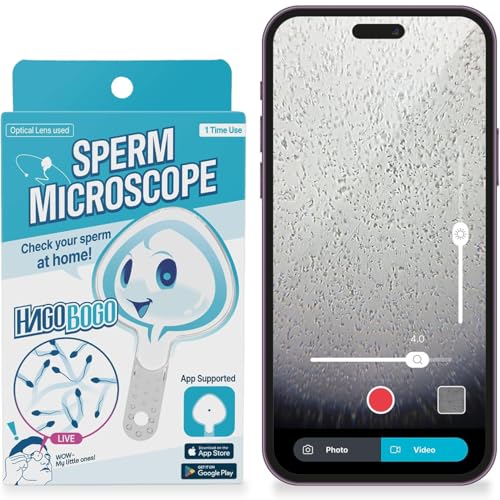
The Hagobogo Sperm Microscope is a single-use optical viewer for personal sperm observation. It is designed to show sperm presence and movement within about 15 minutes, using a prepared sample, the sealed device, and a white light source. At $16.99 for one pack, it offers a low-cost way to view a sample at home without reading a chart or interpreting a score.
A free phone app adds up to 5x magnification through your smartphone camera. It also supports video capture and step-by-step tutorials. The app works with iOS 14.1 or later and Android 10 or later. The device must be discarded after one observation, since moisture or residue can blur the lens or affect the view. This product is for general wellness information only. It does not diagnose infertility or replace a medical evaluation.
Pros
- Provides direct visual feedback on sperm presence and movement in about 15 minutes.
- App support offers up to 5x magnification, video capture, and guided instructions.
- Single-use design avoids cleaning and reuse between observations.
Cons
- One device supports only one observation, so repeated checks require buying more units.
- Visual movement does not provide a clinical sperm count, motility percentage, or diagnosis.
Buying Guide
Optical resolution is the key choice, not the largest advertised magnification. Sperm cells are about 50–60 micrometers long, so clear detail at 400× matters for seeing movement and shape.
- Optical system: Choose a compound microscope with a 40× objective and 10× eyepiece, giving 400× optical magnification. Avoid claims based only on digital zoom.
- Contrast method: Phase contrast makes unstained sperm easier to see than bright-field illumination alone. An adjustable condenser is a useful lower-cost alternative.
- Sample timing: Motility changes quickly. Pick a setup that lets you view a fresh sample within 30–60 minutes, with a clean slide, coverslip, and 37°C warming option.
- Lighting and controls: LED illumination should provide at least 10,000 hours of rated life. Coaxial focus and a mechanical stage make tracking moving cells easier.
- Use and limits: For occasional home checks, a $150–$400 model may suffice. Results are not a medical diagnosis, and fertility testing should use a certified laboratory.
If you cannot have everything, prioritize true 400× optical magnification with strong contrast, since image clarity matters more than extra digital zoom.
Frequently Asked Questions
How much magnification do you need to see sperm?
A microscope with 400x total magnification is usually sufficient for viewing sperm cells, while higher power can help inspect individual movement. Look for a compound model with a 40x objective and 10x eyepiece, plus adjustable lighting. Magnification alone does not measure fertility or confirm that sperm are healthy.
What type of microscope is suitable for viewing sperm?
A compound light microscope is the most practical choice for viewing sperm at home, provided it has transmitted light and fine focus. A brightfield model around 400x can show cells, but phase-contrast optics make unstained, low-contrast sperm easier to see.
Can a home microscope measure sperm count and motility?
A home microscope can show sperm movement, but it cannot reliably measure sperm count or diagnose infertility. A proper semen analysis uses calibrated counting chambers, controlled sample handling, and trained interpretation. For example, motility results can change with temperature and time.
Do digital microscopes provide useful sperm images?
Digital sperm microscopes can provide useful images, but image quality does not prove normal sperm function or fertility. Choose a model with adjustable LED illumination, fine focus, and a camera of at least 1080p for clearer recording on a phone or monitor.
Conclusion
The Hagobogo Spermcheck Sperm Microscope is the top recommendation for buyers who want a purpose-built, straightforward way to view sperm at home. If your priority is broader viewing rather than sperm-focused checks, choose a general digital microscope with adjustable magnification and a phone or computer connection. Before buying, double-check the microscope’s physical size, device compatibility, included sample quantity, and current price, since listings and bundles can change. A home view can support personal observation, but it cannot diagnose infertility or replace a laboratory semen analysis. Follow instructions, and choose a model that fits your space, device, and budget. For fertility concerns, professional testing remains the more reliable next step because it evaluates count, movement, and other factors under controlled conditions.
