
7 Best Catadioptric Telescope Picks for Beginners
For most buyers, the HOROX 80mm Maksutov-Cassegrain Telescope is the best catadioptric telescope because its 80mm aperture and compact optical design balance useful light gathering with easier transport. That combination suits casual stargazing, lunar viewing, and basic planetary observation without requiring a large optical tube. Its Maksutov-Cassegrain layout also keeps the telescope shorter than many traditional designs with similar viewing goals.
This guide is for first-time buyers, backyard observers, and anyone replacing a basic scope. The main factors are aperture, tube size, total weight, mount stability, and included accessories. An 80mm scope can be easier to carry, but it gathers less light than larger models. A steady mount also matters, since small vibrations can make planets difficult to focus. The seven picks below are ranked with clear reasons and honest drawbacks for each.
Quick Comparison
| # | Product | Best For | Price | |
|---|---|---|---|---|
| 1 | HOROX 80mm Maksutov-Cassegrain Telescope | Compact Lunar Viewing | $189.99 | View → |
| 2 | SVBONY MK127 Telescope | Portable Planetary Observation | $479.99 | View → |
| 3 | Celestron NexStar 8SE Computerized Telescope | Automated Deep-Sky Enthusiasts | $1,499.00 | View → |
| 4 | Maksutov-Cassegrain 70mm Catadioptric Telescope | Budget-Conscious Moon Watchers | $129.99 | View → |
| 5 | Celestron StarSense Explorer DX 5 Telescope | Smartphone-Assisted Stargazing | $589.99 | View → |
| 6 | Sarblue Mak60 Maksutov-Cassegrain Telescope | Lightweight Travel Astronomy | $99.99 | View → |
| 7 | Celestron NexStar 5SE Computerized Telescope | Computerized Backyard Observing | $899.00 | View → |
7 Top Catadioptric Telescope Picks
This list is ranked from seventh place down to the top pick, with each catadioptric scope matched to different observing needs.
7. Celestron NexStar 5SE Computerized Telescope

Best for: Visual observers upgrading from manual scopes
At $899, the Celestron NexStar 5SE is a 5-inch Schmidt-Cassegrain telescope with an orange optical tube, computerized GoTo mount, and NexStar+ hand control. Its database contains more than 40,000 celestial objects. Select a target, and the mount slews to it and tracks its position. That setup suits observers who want to spend more time viewing and less time searching through star charts.
SkyAlign simplifies the initial setup. Center any three bright stars or planets, even without knowing their names, and the telescope calculates its alignment in minutes. The 5-inch aperture can reveal detailed lunar terrain, Jupiter’s cloud bands, globular clusters, and some galaxies under suitable skies. Its compact design is easier to transport than many larger instruments. A built-in wedge supports polar alignment for entry-level astrophotography and longer exposures, though serious imaging may require a more specialized mount. The scope includes a two-year warranty, US-based technical support, and compatibility with Celestron accessories.
Pros
- Automated GoTo pointing and tracking cover more than 40,000 objects.
- SkyAlign can align the telescope using three bright stars or planets.
- The 5-inch Schmidt-Cassegrain design balances useful light gathering with portability.
Cons
- The computerized mount requires reliable power, and alignment still takes setup time.
- The built-in wedge helps with entry-level imaging, but the 5-inch aperture and alt-azimuth design limit advanced astrophotography.
6. Sarblue Mak60 Maksutov-Cassegrain Telescope

Best for: Kids and adults starting astronomy
This Sarblue Mak60 is a compact Maksutov-Cassegrain telescope with a 60mm aperture and 750mm focal length. Its optical tube measures about 200mm long, so it fits more easily in a bag than many longer refractor telescopes. The fully multi-coated glass is designed to reduce color and spherical distortion. For a first scope, it should provide clear views of the Moon’s craters, Jupiter, and Saturn under suitable skies. It can also work for daytime subjects, such as birds and distant wildlife.
The package includes a 20mm eyepiece, which produces 37.5x magnification, plus an erect-image diagonal, phone adapter, and tabletop tripod. Setup requires no tools, making it practical for quick observing sessions. A detachable lid exposes the telescope’s internal layout, giving children a useful look at how a catadioptric scope works. Keep fingers and dust away from the mirrors. The included one-year warranty adds basic purchase protection.
Pros
- The 200mm tube keeps a 750mm focal length in a travel-friendly size.
- The 20mm eyepiece provides a useful 37.5x view for the Moon and bright planets.
- The phone adapter supports simple smartphone photos through the eyepiece.
Cons
- The tabletop tripod offers limited height and stability, especially on uneven surfaces.
- A single included eyepiece provides only one magnification, so close-up viewing options are limited without buying more accessories.
5. Celestron StarSense Explorer DX 5 Telescope

Best for: App-guided backyard astronomy
The Celestron StarSense Explorer DX combines a 5-inch, 130mm Schmidt-Cassegrain optical tube with a manual altazimuth mount. Its phone dock works with the StarSense Explorer app, which reads star patterns to identify the telescope’s position. On-screen arrows guide you toward selected targets, then dual-axis slow-motion controls help center them. At $589.99, it targets newcomers who want more guidance than a basic manual telescope provides.
The app creates a location- and time-based list of visible objects, including planets, star clusters, bright nebulae, and galaxies. StarBright XLT coatings support clear views of the Moon, Jupiter, Saturn, the Orion Nebula, and Andromeda. The 5-inch aperture gathers more light than many entry-level scopes, though city skies will still limit faint deep-sky detail. Celestron includes a two-year US warranty and unlimited support from US-based experts.
Pros
- App-based sky recognition helps locate targets without learning star charts first.
- A 130mm optical tube provides detailed lunar and planetary views.
- Manual slow-motion controls allow precise adjustments after finding an object.
Cons
- The mount is manual, so it does not automatically track objects as they move across the sky.
- A 5-inch aperture cannot show every faint galaxy or nebula clearly, especially under heavy city light pollution.
4. Maksutov-Cassegrain 70mm Catadioptric Telescope

Best for: Portable stargazing and phone photos
This $129.99 Maksutov-Cassegrain telescope uses a 70mm aperture and an 830mm focal length in a compact catadioptric tube. Its folded optical path keeps the tube to about 22cm, far shorter than a comparable 830mm refractor. That size makes it easier to pack for camping, travel, or a backyard setup with limited storage space. A smartphone adapter is included for daytime viewing and basic phone photography.
The package also includes an aluminum-alloy tripod with a 46.45-inch maximum height and a base footprint of up to 3.6 square feet. Its two-knob gimbal helps point the scope, while the handle lock holds the chosen position. A fast-focus control and focus indicator should make setup less confusing than a basic single-adjustment mount. The 70mm lens can gather more light than smaller beginner scopes, but buyers should keep expectations realistic. It suits bright targets such as the Moon, Jupiter, and Saturn. Dim galaxies may appear faint, especially under light-polluted skies.
Pros
- The 22cm tube offers useful portability for camping and travel.
- The 70mm aperture supports lunar and planetary viewing.
- The gimbal, lock, and focus indicator simplify target alignment.
Cons
- A 70mm aperture cannot match larger telescopes for faint deep-sky objects.
- The 46.45-inch tripod may feel short for taller adults, and phone results depend on careful alignment.
3. Celestron NexStar 8SE Computerized Telescope

Best for: Serious beginners seeking guided deep-sky views
The Celestron NexStar 8SE is a computerized Schmidt-Cassegrain telescope with an 8-inch optical tube. Its orange tube gives it the classic Celestron look, while the large aperture collects enough light for detailed lunar craters, Jupiter’s cloud bands, globular clusters, and many brighter galaxies. The telescope stays more compact than many larger-aperture designs, but its computerized mount adds useful weight and setup steps.
The GoTo system is the main attraction. The included NexStar+ hand control offers a database of more than 40,000 celestial objects, then moves the telescope to selected targets and tracks them. Celestron’s SkyAlign feature can align the mount after you center three bright stars or planets, even if you do not know their names. That removes much of the guesswork for new users. The scope also supports Celestron accessories for wireless control and other upgrades. A two-year US warranty and ongoing technical support provide useful coverage at this price.
Pros
- 8-inch aperture reveals sharper lunar detail, planetary bands, and many deep-sky targets.
- GoTo tracking locates and follows objects from a database of over 40,000 entries.
- SkyAlign technology supports alignment with three bright stars or planets.
Cons
- $1,499 price places it well above basic manual telescopes and smaller beginner models.
- The computerized mount needs alignment and a suitable power setup, so it is less grab-and-go than a simple tabletop scope.
2. SVBONY MK127 Telescope

Best for: Experienced visual observers and planetary imagers
The SVBONY MK127 is a Maksutov-Cassegrain optical tube with a 127mm aperture and 1,500mm focal length at f/11.8. Its long focal ratio suits the Moon, planets, double stars, and compact deep-sky targets. The tube uses 99% reflectivity dielectric coatings to send more gathered light toward the eyepiece. At $479.99, this is a serious optical upgrade, but it is not a complete telescope setup.
A flat-field design helps keep stars sharper across the view, while the dual-speed focuser supports quick adjustments and finer focusing. The included 0.65x reducer can shorten the effective focal length and improve edge sharpness for some imaging setups. Both 2-inch and 1.25-inch eyepieces are supported, giving buyers broad accessory compatibility. A finder or guide scope can attach through the integrated dovetail slot. For deep-sky photography, a lens hood can reduce stray light and improve contrast. Still, this scope’s narrow field and long focal length demand accurate tracking for long exposures.
Pros
- 127mm aperture gathers useful light for lunar, planetary, and smaller deep-sky targets.
- Dual-speed focusing makes precise adjustments easier at high magnification.
- 2-inch and 1.25-inch interfaces support a wide range of eyepieces and accessories.
Cons
- This is an optical tube assembly, so a compatible mount, tripod, finder, and eyepiece may cost extra.
- The f/11.8 design gives a narrow field and slow imaging speed, limiting wide-field targets and requiring careful tracking.
1. HOROX 80mm Maksutov-Cassegrain Telescope
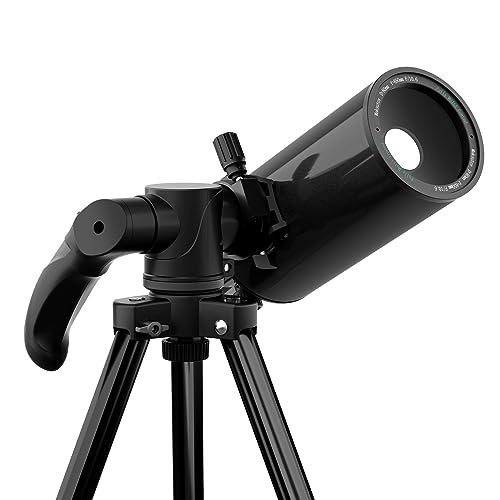
Best for: Campers wanting compact lunar views
At $189.99, the HOROX is a compact Maksutov-Cassegrain telescope with an 80mm aperture and 850mm focal length. Its folded optical path keeps the tube short, measuring about 22cm, while still providing a long focal reach. That makes it easier to pack than a refractor with the same focal length. The 80mm opening gathers useful light for viewing the Moon and brighter targets such as Jupiter, Saturn, and the M31 galaxy.
The included gimbal uses two adjustment knobs for targeting, plus a handle lock to hold its position. A fast-focus system and focus indicator should make setup less frustrating for new users. The reinforced aluminum tripod reaches 46.45 inches and spreads across up to 3.6 square feet. A phone adapter supports basic smartphone photography, and the scope can also work as a long-reach daytime viewing tool. Its short tube helps with travel, but the complete setup still includes a full tripod.
Pros
- 80mm aperture supports clearer views of bright planets and lunar details.
- 22cm tube length makes the optical tube easier to pack for trips.
- Two-knob gimbal and handle lock provide more controlled targeting.
Cons
- An 80mm aperture cannot collect as much light as larger telescopes, limiting views of faint deep-sky objects.
- The 850mm focal length gives a narrow field of view, so finding large or fast-moving targets may take practice.
Buying Guide
The most important factor is aperture, measured in inches or millimeters. A larger opening gathers more light and resolves finer detail, but it also increases weight, price, and setup demands.
- Aperture: Choose 5 to 6 inches for lunar, planetary, and brighter deep-sky viewing. Move to 8 inches if your budget and storage space allow.
- Optical design: Maksutov-Cassegrain models around f/12 to f/15 suit sharp lunar and planetary views. Schmidt-Cassegrain scopes around f/8 to f/10 offer wider targets and more flexible use.
- Mount stability: Pick a mount rated for at least 1.5 times the telescope’s total weight. Motorized tracking helps during high-power viewing, especially above 150x.
- Portability: Check the assembled weight and tube length. A setup under 30 pounds and roughly 30 inches long is easier to carry outside or transport by car.
- Accessories and price: Budget $700 to $2,500 for a capable 5- to 8-inch system. Confirm that it includes a tripod, finder, diagonal, and at least one 20mm to 25mm eyepiece.
If you cannot have everything, prioritize aperture only after choosing a mount sturdy enough for steady views.
Frequently Asked Questions
How do you choose a catadioptric telescope for home use?
Choose a Schmidt-Cassegrain as a versatile catadioptric telescope for visual observing and astrophotography. Its folded optical path keeps the tube short, while a corrector plate and mirrors provide long focal length. A common 8-inch model measures about 16 inches long but offers roughly a 2,000mm focal length.
What size catadioptric telescope is best for most people?
An 8-inch catadioptric telescope is a strong general-purpose size for many observers, balancing light gathering, portability, and cost. A 6-inch version weighs less and cools faster, while an 8-inch mirror gathers nearly 78 percent more light than a 6-inch mirror, useful for planets and faint deep-sky objects.
Can catadioptric telescopes be used for astrophotography?
Yes, catadioptric telescopes can work well for astrophotography, but they need a sturdy mount and often a focal reducer. Their long focal lengths suit planets and small deep-sky targets, though tracking errors show quickly. For example, a 2,000mm setup demands more accurate guiding than a 500mm refractor.
Are catadioptric telescopes good for beginners?
Yes, catadioptric telescopes can suit beginners who value compact storage and automated tracking, but simpler mounts and moderate apertures are easier to learn. An 8-inch computerized model may weigh over 20 pounds once the tripod and accessories are included, so transport and setup deserve careful consideration.
Conclusion
The HOROX 80mm Maksutov-Cassegrain Telescope is the top choice for buyers who want a compact, focused setup for lunar, planetary, and casual backyard viewing. If your priority is brighter deep-sky viewing, choose the larger-aperture model from the roundup instead, since its wider light-gathering capacity can reveal more detail under dark skies. Before buying, double-check the telescope’s physical size, tripod and mount compatibility, included accessory quantity, and current price. Also confirm that the package includes the eyepieces, finder, and adapters you need, since included items can vary between listings. A compact catadioptric scope saves storage space, but its narrower field of view may feel limiting for large star clusters or wide nebulae.
