
5 Best Dissecting Microscopes for Botany Students
The AmScope 3.5X-45X Zoom Stereo Microscope is the top pick and the best dissecting microscope for botany for most buyers, mainly because its wide zoom range handles everything from small plant structures to larger samples without switching objectives. Its stereo view also gives specimens useful depth, making leaf veins, stems, buds, and insects easier to inspect.
This guide is for students, home gardeners, teachers, and anyone comparing a bench-top scope for plant work. Pay closest attention to working distance and illumination, since both affect how easily you can position a specimen and see fine detail. A stable stand, adjustable LED lighting, and enough room beneath the objective matter too. The five picks below are ranked with clear reasons and honest drawbacks for each.
Quick Comparison
| # | Product | Best For | Price | |
|---|---|---|---|---|
| 1 | AmScope 3.5X-45X Zoom Stereo Microscope | High-Magnification Hobbyist Inspection | $449.99 | View → |
| 2 | OMAX G223C-A189V Binocular Microscope | Classroom Biology Students | $214.99 | View → |
| 3 | AmScope SE100-X-LED Binocular Stereo Dissecting Microscope | Hands-On Dissection Learners | $67.99 | View → |
| 4 | AmScope NZ1903-S Trinocular Stereo Zoom Microscope | Microscope Camera Documentation | $599.99 | View → |
| 5 | AmScope BK-EXCL1 Microscope Activity Cards | Kids’ Guided Microscope Activities | $19.99 | View → |
5 Top Dissecting Microscopes for Botany
This ranked list compares five botanical dissecting microscopes, counting down from solid options to the top pick.
5. AmScope BK-EXCL1 Microscope Activity Cards

Best for: Families starting microscope activities
The AmScope BK-EXCL1 is a set of six laminated plastic experiment cards for children learning microscope basics. Priced at $19.99, it covers more than 14 activities, including slide preparation, plant and animal cells, biology, botany, and simple geology. The cards also explain microscope parts and their functions, giving young learners a starting point before they begin lab-style activities.
What sets this set apart is its reusable format. Each card uses colorful illustrations and step-by-step directions, so children can follow the projects without working through a full textbook. The plastic coating helps prevent rips and tears, and the cards can be cleaned with soap and warm water after use. They fit home lessons, classroom stations, or travel kits. Still, the cards are activity guides, not a complete microscope kit, so families may need to supply the microscope, slides, and other materials separately.
Pros
- Includes more than 14 activities across biology, botany, cells, and geology.
- Six laminated plastic cards resist tearing and clean up with soap and warm water.
- Illustrated, step-by-step directions introduce microscope parts and slide preparation.
Cons
- The set does not include a microscope or clearly list all required experiment supplies.
- Six cards may offer less depth than a full workbook or structured science curriculum.
4. AmScope NZ1903-S Trinocular Stereo Zoom Microscope

Best for: Student labs and specimen study
The AmScope NZ1903-S is a trinocular stereo zoom microscope designed for classroom work, basic research, and detailed specimen viewing. Its zoom range runs from 6.7X to 45X, giving users room to examine larger samples and move toward finer details without changing objective lenses. The package includes two HWF 10x/22mm eyepieces, which provide a wide viewing field for comfortable observation.
Its lighting setup is a practical strength. Two 3W LED lights provide illumination from above and below, making the system suitable for opaque objects and thinner specimens. The built-in power supply accepts 110-240V, so it can work across a broad range of electrical systems. An ergonomic pillar stand supports the viewing head and keeps the microscope suited to a fixed workbench. The trinocular design also leaves a separate port for adding a camera later, though the listed package does not include one. At $599.99, it offers useful features for students without moving into advanced laboratory pricing.
Pros
- 6.7X-45X zoom covers both broad inspection and closer specimen work.
- Dual 3W LED illumination supports top and bottom lighting.
- Included 10x/22mm eyepieces provide a wide viewing area.
Cons
- A camera is not listed, so photo or video work requires extra equipment.
- The pillar stand and integrated power supply make it better for bench use than portable viewing.
3. AmScope SE100-X-LED Binocular Stereo Dissecting Microscope

Best for: Kids inspecting rocks and stamps
The AmScope SE100-X-LED is a simple binocular stereo microscope for home projects and classroom observation. Its 2x objective leaves more room to handle larger items, such as rocks, coins, jewelry, biological specimens, and stamps. Two interchangeable eyepiece pairs, 5x and 10x, create 10x or 20x viewing options. That range suits surface details without forcing the user to work close to the lens.
The binocular head has adjustable interpupillary distance, so users can match the eyepieces to their eyes. Its vertical angle stays fixed, which keeps the setup straightforward for younger students. A battery-powered 1W LED shines from above, making it useful for opaque objects that need reflected light. The reversible stage plate offers black and white sides for contrast, while metal stage clips help hold specimens in place. At $67.99, this is a basic option for guided observation rather than advanced microscopy.
Pros
- Low 2x objective: Leaves working space for larger specimens and hands-on inspection.
- Two eyepiece pairs: Provides 10x and 20x magnification choices for different surface details.
- Battery-powered 1W LED: Lights objects from above without requiring a wall outlet.
Cons
- 20x maximum magnification: Cannot show the fine details or cellular structures that higher-power microscopes can reveal.
- Fixed viewing angle: Users can adjust the interpupillary distance, but not the binocular head’s vertical tilt.
2. OMAX G223C-A189V Binocular Microscope
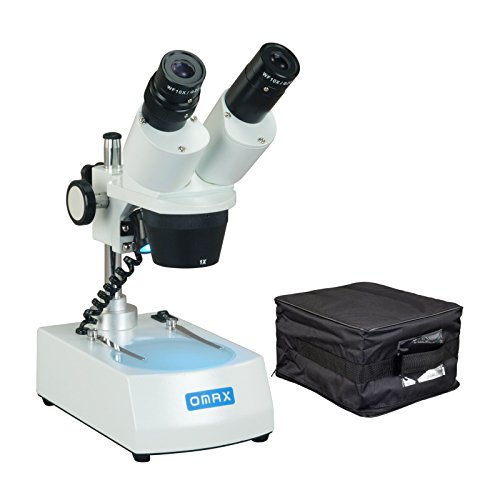
Best for: Hobbyists inspecting small objects
The OMAX G223C-A189V is a binocular stereo microscope for coins, electronics, insects, jewelry, and similar objects. It offers 10X and 30X total magnification through WF10X/20 widefield eyepieces and rotating 1X and 3X objectives. Its 45-degree viewing head includes locked-in eyepieces, left-side diopter adjustment, and interpupillary spacing from 55mm to 75mm. The 57mm working distance gives you room to position an item beneath the optics.
Two LED illuminators add flexibility. The upper light shines onto solid objects, while the lower light passes through translucent samples. The 95mm frosted glass stage includes a black-and-white plastic plate for contrast changes. Its all-metal mechanical components should suit regular bench use, while the included vinyl case helps with storage and transport. Power comes from a 120V adapter or three AA batteries. At $214.99, the microscope also includes a five-year warranty against manufacturing defects.
Pros
- Dual upper and lower LEDs support both solid and translucent samples.
- Binocular optics, 45-degree viewing, and 55mm to 75mm spacing accommodate different users.
- 57mm working distance leaves practical room for handling objects under the lens.
Cons
- The 10X and 30X options provide less magnification flexibility than models with more objective choices.
- Three AA batteries add ongoing replacement costs, while the included vinyl case offers limited protection compared with a hard case.
1. AmScope 3.5X-45X Zoom Stereo Microscope

Best for: Detailed hobby and repair work
The AmScope 3.5X-45X stereo microscope is built for inspection, dissection, soldering, model work, and other tasks that need depth perception. Its zoom range lets you move from a broad view to close detail without changing eyepieces. The super-widefield optics provide a 2-1/2-inch, or 65mm, field of view, while the 8-inch, or 200mm, working distance leaves room for tools and larger parts.
Its all-metal pillar stand should provide a steadier platform than a lightweight plastic base. The 64-LED ring light supplies even illumination around the viewing area, and its dimmer lets you reduce glare on shiny surfaces. The high-eyepoint design may also suit users who wear glasses. At $449.99, this scope targets serious hobbyists, repair benches, and small workshops rather than casual viewing. The 3.5X-45X range offers useful flexibility, but it remains an inspection scope rather than a high-power compound microscope.
Pros
- The 3.5X-45X zoom range supports both broad inspections and fine detail work.
- A 65mm field of view makes it easier to track larger parts.
- The 64-LED ring light includes a dimmer for adjustable surface lighting.
Cons
- Its 45X maximum magnification is limited for cellular or slide-based specimens.
- The metal pillar stand may be less convenient to move than a compact portable stand.
Buying Guide
Optical clarity is the most important factor when choosing a plant dissection microscope. Clear stereo images help you distinguish leaf veins, pollen, roots, and small insects without eye strain.
- Magnification range: Choose 10x to 40x total magnification for most botany work. A 20x to 80x zoom range suits tiny seeds, spores, and flower parts.
- Working distance: Look for at least 3 inches between the lens and specimen. A 4- to 6-inch distance gives more room for forceps, scalpels, and small dishes.
- Illumination: Select a model with both top and bottom LED lights. Adjustable brightness helps with reflective leaves, dark soil, and transparent stems.
- Optical system: A binocular stereo design gives depth perception and reduces viewing fatigue. Glass eyepieces with 10x magnification usually provide a clearer view than basic plastic optics.
- Stand and accessories: Choose a metal stand with a base at least 6 by 8 inches. A dust cover, stage plate, and two 10x eyepieces add useful value, while a camera port helps document specimens.
If you cannot have everything, prioritize optical clarity and a 3-inch or longer working distance.
Frequently Asked Questions
How do I choose a dissecting microscope for botany?
A good botanical dissecting microscope should offer 10x to 40x magnification, clear optics, and enough working distance for leaves, seeds, and small specimens. Choose stereo viewing, adjustable lighting, and a stable base. A 20x setting works for leaf veins, while 40x can show surface hairs and insect damage.
What magnification do I need for plant specimens?
Most botany work needs 10x to 40x total magnification, rather than extreme power. Lower settings help you survey whole specimens, while higher settings reveal trichomes, pollen structures, and small pests. A zoom range such as 7x to 45x gives finer control, but image brightness and working distance still matter.
Can a stereo microscope work for plant dissection?
Yes, a stereo microscope is suitable for examining plant parts because it provides depth perception and room to position tools. It can show stems, buds, seeds, and leaf surfaces in three dimensions. For dissection, look for at least 70 mm of working distance and paired top and bottom illumination.
Are LED lights useful on a botanical microscope?
Yes, LED illumination is usually the best choice for botanical stereo microscopes because it runs cool and provides controllable light. A ring light reduces shadows on rounded seeds, while a gooseneck or transmitted light source helps with thin leaves. Adjustable brightness matters more than raw lamp power for delicate specimens.
Conclusion
The AmScope 3.5X-45X Zoom Stereo Microscope is the top pick for botanists, students, and hobby growers who need broad magnification for examining leaves, stems, seeds, and small plant structures. If your priority is a lower-cost setup for occasional work, choose a simpler stereo microscope with a narrower zoom range and fewer accessories. Before buying, double-check the microscope’s size, camera and stand compatibility, included accessory quantity, and current price, since listings can change. Its 3.5X to 45X range lets you scan larger samples, then inspect fine details without switching objectives. Your workspace matters as much as magnification, so leave room for specimens, lighting, and comfortable viewing. Good ergonomics will make repeated plant study easier.
