
5 Best 75 Keyboard Pcb for Budget Builds
The GTSP M87 Barebones Keyboard Kit is the top pick for most buyers seeking the best 75 keyboard pcb because it provides a flexible starting point for a custom mechanical keyboard. Its barebones format lets shoppers choose compatible switches, keycaps, and stabilizers instead of paying for a fully assembled board.
This guide is for anyone comparing compact mechanical keyboards and barebones kits before buying. The main checks are layout, PCB support for hot-swap or soldered switches, and firmware compatibility. Check those details first, since a mismatched board can limit parts choices or require extra work. The five picks below are ranked with clear reasons and honest drawbacks for each, so you can choose a setup that fits your build plans.
Quick Comparison
| # | Product | Best For | Price | |
|---|---|---|---|---|
| 1 | GTSP M87 Barebones Keyboard Kit | Custom keyboard first-builders | $34.99 | View → |
| 2 | GTSP M87 Barebones Mechanical Keyboard Kit | Switch and keycap tinkerers | $36.99 | View → |
| 3 | AULA F75 Pro Wireless Mechanical Keyboard | Multi-device wireless users | — | View → |
| 4 | LEOBOG Hi75C Mechanical Keyboard Kit | Aluminum case enthusiasts | $65.99 | View → |
| 5 | RK ROYAL KLUDGE M75 Mechanical Gaming Keyboard | Budget gaming setup builders | $69.99 | View → |
5 Top 75% Keyboard PCB Picks
These five PCB options are ranked by features, compatibility, and value, counting down to the top pick.
5. RK ROYAL KLUDGE M75 Mechanical Gaming Keyboard

Best for: Competitive PC gamers seeking rapid inputs
At $69.99, the RK ROYAL KLUDGE M75 is a wired 75% mechanical gaming keyboard. Its compact layout keeps the arrow keys and leaves out the number pad, saving desk space. A metal volume knob handles scrolling and instant mute. The top-mounted design uses an aluminum plate and sound-dampening foam for a firmer, quieter typing feel.
Its Hall Effect magnetic switches are the main attraction. The keyboard supports an 8000Hz polling rate, 0.125ms latency, Rapid Trigger, and actuation settings from 0.1mm to 3.3mm. Those controls suit players who want quick, adjustable inputs. The universal hot-swap PCB also accepts Hall Effect, custom, or mechanical switches, with a listed 100-million-click lifespan. RGB lighting shines through four sides of the PBT keycaps, while five-side dye-sublimated legends resist fading. The browser-based driver handles remapping, macros, and lighting changes.
Pros
- Adjustable 0.1mm to 3.3mm actuation lets users tune key response.
- The 75% layout keeps arrow keys while using less desk space.
- PBT keycaps, RGB side glow, and a metal knob add useful hardware details.
Cons
- The wired design offers no wireless option for flexible desk setups.
- The compact layout removes the number pad, which can slow data entry.
4. LEOBOG Hi75C Mechanical Keyboard Kit
Best for: Custom desktop setups and gaming
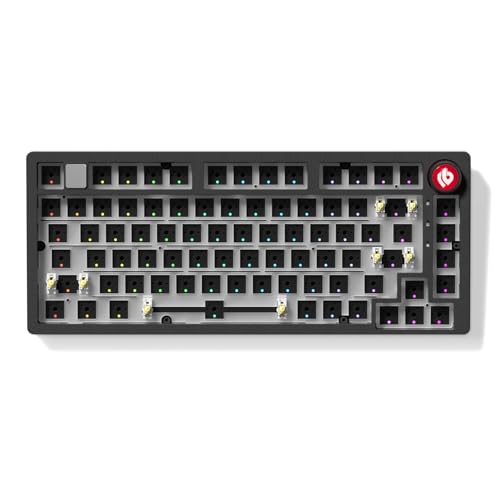
The LEOBOG Hi75C is a wired 75% mechanical keyboard kit with a CNC-machined aluminum alloy case. Its compact layout keeps the arrow keys and function row while saving desk space, though it leaves out a number pad. The hot-swappable PCB accepts both 3-pin and 5-pin switches, so you can change the typing feel without soldering. A USB-C port connects to the included USB-A cable, which measures about 1.8 to 2 meters.
Its strongest features focus on daily control and customization. The gasket mount adds cushioning between the plate and case, while the revised PCB aims for steadier input and cleaner sound. RGB lighting offers 17 preset effects, plus 10 music-reactive modes and a wide color range. A rotary volume knob and separate mute button keep audio adjustments quick. Compatible software supports remapping, macros, layers, and firmware updates. At $65.99, this kit offers many enthusiast features for a moderate price, but buyers should confirm what other components come in the package.
Pros
- Aluminum alloy construction gives the keyboard a rigid, durable case.
- Hot-swappable support accepts common 3-pin and 5-pin switches.
- The knob, mute button, RGB effects, and macro tools add practical control.
Cons
- The wired-only design offers no Bluetooth or 2.4GHz wireless option.
- The 75% layout lacks a dedicated number pad, which may slow spreadsheet work.
3. AULA F75 Pro Wireless Mechanical Keyboard

Best for: compact wireless gaming and office setups
The AULA F75 Pro is an 81-key, 75% mechanical keyboard with three connection options: Bluetooth 5.0, 2.4GHz wireless, and USB-C. It can pair with up to five devices, including computers, tablets, phones, PS consoles, and Xbox systems. A 4000mAh rechargeable battery supports wireless use, though the listing does not give a runtime estimate. Its compact layout keeps arrow keys while taking less desk space than a full-size board.
Several details make this keyboard more customizable than a basic gaming model. The hot-swap PCB accepts both 3-pin and 5-pin switches, so replacements do not require soldering. Pre-lubed Reaper switches, stabilizers, five layers of sound-dampening material, and single-key PCB slotting aim to reduce hollow noise and add a softer feel. Side-printed PBT keycaps use a durable molded design, while RGB lighting offers 16 preset effects and 10 music-reactive modes through the driver. A multifunction knob controls lighting or media after switching between gaming and office modes.
Pros
- Tri-mode connectivity supports up to five paired devices.
- Hot-swap sockets accept 3-pin and 5-pin switches.
- 4000mAh battery supports cable-free desk setups.
Cons
- The 75% layout has no dedicated number pad.
- Wireless battery runtime and product price are not specified.
2. GTSP M87 Barebones Mechanical Keyboard Kit

Best for: First-time custom keyboard builders
The GTSP M87 kit is a compact, barebones mechanical keyboard with a 75% layout and gasket-mounted construction. At $36.99, it offers a low-cost entry into keyboard customization. The hot-swap PCB accepts both 3-pin and 5-pin MX-style switches from brands such as Cherry, Gateron, Kailh, and Outemu. Since this is a barebones kit, buyers should plan to source compatible switches and keycaps separately.
Its strongest feature set focuses on flexibility. Sound-absorbing foam and a silicone bottom pad aim to reduce case noise, while south-facing RGB lighting supports a wide range of keycap profiles. The board includes 18 built-in lighting and music-reactive modes, plus software for custom effects, macros, and per-key lighting. Full-key anti-ghosting and NKRO suit gaming, and the detachable USB-C cable makes storage easier. Windows and Mac compatibility adds practical value, though software support may differ by operating system.
Pros
- Hot-swap sockets support 3-pin and 5-pin switches without soldering.
- Foam and silicone padding can reduce hollow case noise.
- Eighteen lighting modes, custom effects, and macro support offer strong personalization.
Cons
- The barebones kit requires separate switches and keycaps, raising the final cost.
- Custom software features may be less convenient on Mac than on Windows.
1. GTSP M87 Barebones Keyboard Kit

Best for: Budget-minded DIY keyboard builders
This $34.99 GTSP M87 kit is a barebones mechanical keyboard for Windows and Mac. The listing calls it a 75% custom kit, while the product name also says TKL, so check the layout image before ordering. It includes the PCB, case, stabilizers, foam, silicone bottom pad, and detachable USB-C cable. You supply the switches and keycaps. Its gasket-mounted construction is designed to add flex and soften key impacts.
The hot-swap PCB is the main draw. It accepts 3-pin and 5-pin MX-style switches from Cherry, Gateron, Kailh, and similar brands without soldering. NKRO and full-key anti-ghosting support gaming, while South-Facing RGB provides per-key lighting. You get 18 built-in lighting and music-reactive modes, plus software for custom effects and macros. Foam and silicone should reduce case noise, but the final sound depends on your switches and keycaps.
Pros
- Hot-swap sockets accept 3-pin and 5-pin switches without soldering.
- Foam and a silicone bottom pad help reduce case resonance.
- Software supports macros, custom effects, and per-key lighting.
Cons
- Switches and keycaps are not included, increasing the finished cost.
- Conflicting 75% and TKL descriptions make the layout unclear before purchase.
Buying Guide
The most important factor is case and plate compatibility. A 75% circuit board can use different mounting points, screw locations, and layouts, so an incompatible PCB may not fit your keyboard.
- Layout support: Confirm the board matches your 75% layout, including 80 to 84 keys, right-shift size, and bottom-row spacing. A 1.75u right Shift is common, but not universal.
- Mounting pattern: Compare screw holes and mounting style with your case. Some PCBs support tray mount, while others use gasket tabs, top mount, or 8 to 12 specific mounting points.
- Switch compatibility: Choose hot-swap sockets for tool-free switch changes. Check whether the PCB accepts 3-pin or 5-pin MX switches, since 3-pin support may require clipped stabilizer legs.
- Firmware and connection: QMK or VIA support makes remapping easier. Prefer USB-C with a detachable cable, and confirm the board supports your operating system before purchase.
- Price and included parts: Bare PCBs often cost about $35 to $90. Check for stabilizers, screws, daughterboards, foam, and a USB cable, since missing parts can add $15 to $40.
If you cannot have everything, prioritize physical compatibility over firmware features or included accessories.
Frequently Asked Questions
How do I choose a 75% keyboard PCB?
Choose a 75% keyboard PCB by matching its layout, mounting style, firmware support, and switch connection to your case and build plan. Most 75% boards use 80 to 84 keys, but knob, blocker, and arrow-key layouts can change compatibility. Check the product diagram before ordering.
What makes a 75% PCB good for a custom keyboard?
A good 75% PCB supports stable mounting, reliable firmware, and the exact switch layout you want. Look for QMK or VIA support if you want remapping, plus USB-C connectivity and clear documentation for plates, daughterboards, and case screws. Compatibility matters more than extra lighting features.
Can I use a 75% PCB in any 75% case?
No, you cannot use every 75% PCB in every 75% case because screw points, USB placement, plate shape, and layout spacing can differ. Check the listed case and PCB model numbers before buying. An 80-key ANSI board may not fit an 84-key layout, even when both share the same general format.
Are hot-swap 75% PCBs better than solder versions?
Hot-swap 75% PCBs are better for frequent switch changes, while solder PCBs suit permanent builds and custom switch wiring. Hot-swap sockets let you replace switches without soldering, but they add a failure point and may support only 3-pin or 5-pin switches. Choose based on maintenance needs, not convenience alone.
Conclusion
The GTSP M87 Barebones Keyboard Kit is the top choice for buyers who want a ready-to-assemble starting point, not just a loose circuit board. If your priority is easier switch changes, choose a hot-swappable alternative instead, because it avoids soldering when you replace switches. Before buying, double-check the size, case compatibility, layout support, included board quantity, and current price. Also confirm whether the package includes a case, plate, stabilizers, switches, or keycaps, since “barebones” often means several parts remain separate. That can change the final cost and assembly time. Pick the board that matches your intended layout and budget, then confirm its connector and firmware needs before checkout.
