
5 Best Stereo Microscope for Entomology for Insect Work
For most buyers, the ZTEEERS Trinocular Stereo Zoom Microscope is the best stereo microscope for entomology because its three-port design lets you view specimens while keeping a separate camera port available. That setup suits insect identification, close-up study, and creating images without blocking the eyepieces. It is a practical choice for hobbyists, students, and small teaching labs.
This guide is for anyone who needs a stereo viewer for pinned insects, live specimens, minerals, or delicate field finds. The key factors are usable magnification and working distance, since tiny details require enough zoom without forcing the specimen against the lens. Lighting control also matters for revealing wings, legs, and surface texture. The five picks below are ranked with clear reasons and honest drawbacks for each, so you can match the microscope to your workspace and budget.
Quick Comparison
| # | Product | Best For | Price | |
|---|---|---|---|---|
| 1 | ZTEEERS Trinocular Stereo Zoom Microscope | Camera-Ready Inspection Workstations | $429.99 | View → |
| 2 | Aomekie Stereo Microscope | Hobbyists Exploring Large Specimens | $59.99 | View → |
| 3 | Compound Microscope Kit | School Science Experiment Stations | $74.77 | View → |
| 4 | Euromex Stereoblue Trinocular Stereo Microscope | Research Teams Needing Trinocular Viewing | $877.68 | View → |
| 5 | AmScope SE306R-PZ Binocular Stereo Microscope | Jewelry Repair and Soldering | $221.99 | View → |
5 Top Stereo Microscopes for Entomology
This list is ranked by optics, working distance, lighting, and value, counting down to the top pick.
5. AmScope SE306R-PZ Binocular Stereo Microscope

Best for: Hobbyists inspecting small objects
The AmScope SE306R-PZ is a binocular stereo microscope for close-up inspection, repair, crafts, and classroom work. Its WF10x and WF20x eyepieces combine with the optical system to provide 20X, 40X, and 80X viewing. That range covers basic surface checks and more detailed work on small parts.
Its strongest feature is the practical lighting setup. A built-in incident light shines down from above, while a transmitted light illuminates items from below. That makes the scope useful for both solid objects and thin samples. The widefield optical glass lenses should provide a broader viewing area than narrow-field optics, and the forward-facing binocular head gives a more natural viewing position. At $221.99, the all-metal pillar stand also adds a solid base for routine use. Still, this is a straightforward viewing microscope, not an imaging system or a research-grade instrument.
Pros
- Three magnification choices, 20X, 40X, and 80X, support different inspection tasks.
- Top and bottom lights handle opaque objects and translucent samples.
- The all-metal pillar stand provides a sturdy platform for hands-on work.
Cons
- The microscope uses set magnification levels rather than a continuous zoom range.
- No camera port or imaging accessories are listed, limiting photo and video documentation.
4. Euromex Stereoblue Trinocular Stereo Microscope

Best for: Professional inspection and teaching labs
The Trinocular Stereo Microscope Stereoblue is a professional optical system for examining specimens, components, insects, minerals, and small precision work. Its 0.7X to 4.5X zoom objective provides 7X to 45X magnification. A 100 mm working distance leaves useful room beneath the lens for handling samples or tools. The rack-and-pinion stand supports controlled focusing from either side of the head holder.
Its 45-degree inclined viewing head helps create a more comfortable working position. The eyepiece tubes accept WF10X/21 mm eyepieces and offer interpupillary adjustment from 55 to 75 mm. Each tube also has plus-or-minus 5 mm diopter adjustment, which helps users match focus between their eyes. A 3W LED provides both incident and transmitted light, and both modes can run at the same time. The plain stage includes clips, black and white plates, and a translucent plate. At $877.68, this microscope targets laboratories, classrooms, and professional workbenches rather than casual hobby use.
Pros
- 7X to 45X zoom covers broad viewing and detailed inspection.
- Dual 3W LED lighting handles objects viewed from above or below.
- Trinocular head leaves room for camera integration while keeping binocular viewing available.
Cons
- The listed package does not include a camera, so imaging requires a separate purchase.
- A 45X maximum may feel limiting for work that needs higher magnification.
3. Compound Microscope Kit

Best for: Homeschool science lessons and beginners
At $74.77, this compound microscope offers six listed magnification settings: 100x, 250x, 1,000x, 200x, 500x, and 2,000x. Its WF25x eyepiece works alone or with the included 2x lens, while 4x, 10x, and 40x objectives support different viewing needs. A metal frame gives the instrument a sturdier build than many lightweight student models. The adjustable dual LED system also provides top and bottom lighting, so users can view opaque items such as coins or translucent specimens.
The package includes prepared slides and covers, blank slides, droppers, tweezers, instructions, and a phone adapter. The listed beginner kit contains 11 pieces, giving children several materials for their first observations. Its 1-to-8-level lighting controls help adjust brightness, while the five-color disk aperture can change contrast and limit stray light. Power comes from an included AC adapter or three AA batteries, which are not included. The high 2,000x setting sounds impressive, but it requires careful focusing and specimens suited to that level.
Pros
- Six magnification settings cover basic classroom and hobby observations.
- Metal construction should provide better durability than an all-plastic frame.
- Prepared slides, blank slides, tools, and a phone adapter add useful starter equipment.
Cons
- Three AA batteries are required for battery use and must be purchased separately.
- The 2,000x setting may be difficult for young children to focus accurately.
2. Aomekie Stereo Microscope

Best for: Kids exploring rocks, insects, and stamps
The Aomekie® stereo microscope offers 20X and 50X magnification through WF10X and WF25X eyepieces paired with a 2X objective. Its 65mm to 102mm working range leaves room for larger objects, such as rocks, jewelry, circuit boards, and insect specimens. Binocular viewing lets users look through both eyepieces, while the 55mm to 75mm interpupillary adjustment fits different users.
The included starter materials make this kit more useful than a microscope alone. It comes with 10 prepared slides, insect specimens, and 12 mineral specimens for immediate exploration. An LED illuminates the viewing area, and two AA batteries, sold separately, let users move the scope away from an outlet. The fixed vertical angle and rotatable focus knob should make positioning straightforward for home or classroom use. At $59.99, this is an entry-level stereo scope for surface details, not a tool for viewing individual cells or producing laboratory-grade images.
Pros
- Two magnification choices, 20X and 50X, cover small objects and larger specimens.
- The 65mm to 102mm working distance accommodates rocks, insects, jewelry, and circuit boards.
- Included slides, insects, and 12 mineral specimens provide activities right out of the box.
Cons
- Two AA batteries are required but not included, adding an extra purchase before cordless use.
- The 20X and 50X range is limited for very small details, such as individual cells or fine laboratory samples.
1. ZTEEERS Trinocular Stereo Zoom Microscope
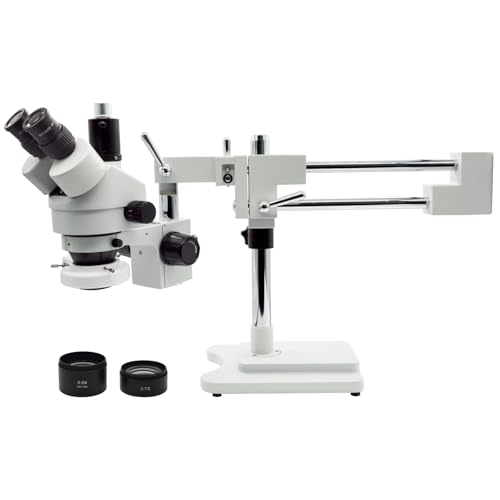
Best for: Detailed repair, inspection, and specimen work
The ZTEEERS Professional Trinocular Stereo Zoom Microscope is a versatile inspection setup priced at $429.99. It includes WF10X super-widefield eyepieces, a 0.7X-4.5X zoom objective, 0.5X and 2.0X auxiliary lenses, and a 56S LED ring light. The optical system covers 3.5X to 90X, giving buyers room for both larger objects and fine detail. A trinocular port also supports a digital camera or HD touchscreen, although those accessories are not included.
Several practical details separate this model from simpler stereo microscopes. The eyepieces adjust from 48 to 75mm, and each ocular tube offers plus or minus 6 diopter adjustment for uneven eyesight. The head tilts at 45 degrees and rotates 360 degrees, which helps when multiple people need to view the same subject. Its 18-pound solid-steel rectangular base should resist movement, while the double-arm boom offers flexible positioning. The ring light provides shadow-free illumination with a dimmer for brightness control. Camera users can observe through both eyepieces while recording through the trinocular port.
Pros
- Wide 3.5X-90X range handles broad inspections and small details.
- 18-pound steel base gives the stand a stable foundation.
- Adjustable ring light provides focused illumination without harsh shadows.
Cons
- The 18-pound base makes this microscope difficult to move often.
- A camera or HD display requires a separate purchase, adding to the total cost.
Buying Guide
Working distance is the most important factor for insect study. A clearance of at least 4 inches gives room for forceps, pins, and larger specimens without hitting the objective.
- Working distance: Choose 3.5 to 6 inches, especially for beetles, butterflies, and pinned displays. Shorter distances make handling awkward.
- Magnification range: Look for 10x to 40x total magnification. A 20x to 80x zoom is useful for tiny mites, but high power can narrow the viewing area.
- Lighting: Select adjustable LED lighting with both top and bottom illumination. A ring light helps with surface detail, while transmitted light suits wings and thin parts.
- Viewing comfort: Binocular eyepieces reduce eye strain during long sessions. Choose 10x eyepieces with a field number of at least 20, plus interpupillary adjustment around 2 to 3 inches.
- Stand and stage: Pick a metal stand with a 4-by-4-inch or larger stage. A wide base and locking focus control help when positioning pinned insects or live specimens.
If you cannot have everything, prioritize working distance, since usable clearance affects both specimen handling and image clarity.
Frequently Asked Questions
How do I choose a stereo microscope for studying insects?
Choose a stereo microscope with 10x to 20x eyepieces, a zoom range near 7x to 45x, and enough working distance for handling specimens. A binocular head reduces eye strain during longer sessions, while ring illumination helps reveal legs, wings, and surface texture without harsh shadows on small insects.
What magnification is best for viewing insects with a stereo microscope?
A 10x to 40x total magnification suits most insect identification, while 60x or higher helps inspect tiny mites, scales, and mouthparts. Start at the lowest setting for a wider view, then increase power when you need detail. Higher magnification usually reduces field of view and working distance.
Can I use a dissecting microscope for live insect observation?
Yes, a dissecting microscope works well for observing live insects because it provides a three-dimensional view and useful working space. Choose a model with a long working distance, ideally 70 mm or more, and use cool LED lighting to limit heat near delicate specimens.
Are LED lights better for insect photography under a stereo microscope?
Yes, LED illumination is usually better for insect photography because it produces steady light with less heat than many older bulbs. A dimmable ring light gives even coverage, while a dual-arm light adds directional shadows. Look for adjustable brightness and a color temperature around 5,000 to 6,500K for natural-looking images.
Conclusion
ZTEEERS Trinocular Stereo Zoom Microscope is the top pick for serious insect hobbyists, students, and researchers who want binocular viewing plus a camera-ready trinocular port. If your priority is a lower upfront cost or simpler setup, pick a binocular stereo microscope instead, since fewer ports and accessories can reduce expense without affecting routine specimen viewing. Before buying, double-check the microscope’s overall size, camera and eyepiece compatibility, included accessory quantity, and current price. Also confirm that the working distance and zoom range fit your beetles, butterflies, pinned specimens, or live subjects. A sturdy stand and adjustable illumination matter during long observation sessions. Good optics help, but the right fit prevents wasted money and cramped bench space.
